Holophonic composition · the spectromorphological score · the sonorous score
06
Conclusion
Composing relations between morphologies: a typology and a method
To begin · four questions
Questions to listen with
1
Choose one sound. Describe it only by its morphology — never by its cause.
2
How would you notate that shape so another performer finds their own technique for it?
3
When you put two sounds together, what relates them? A shared criterion, a transformation, a superposition, a succession?
4
What would a form look like if it were decided by how the performers play, rather than by the clock?
01 · Introduction
Joan Bagés i Rubí
composer · pianist · sound artist · www.joanbages.com
His work spans instrumental music, electroacoustic music, sound installations and interactive music systems — not as separate fields, but as a continuum of networks between them.
What unifies it is a permanent research into what he calls “spectro-morphological composition in differentiated layers within a holophonic framework”.
Works performed in many countries and awarded in international competitions · grants and commissions from the Generalitat de Catalunya, Fundació Phonos, INAEM-CDMC and SACEM, among others.
A trajectory between the piano, the studio and the score
BARCELONAPiano diploma, Conservatori del Liceu · Master in Digital Arts – Music, UPF (2002): composition, electroacoustics and interactive systems.
PARISUniversité Paris 8 — DEA and doctorate in Esthétique, sciences et technologies des arts (H. Vaggione, A. Sedes) · composition with J. M. López López. The sound object, the studio, the research.
BERLINComposition studies with Rebecca Saunders: sound as matter, the question of the sound palette, “the weight of every gesture and every silence”.
BARCELONAArtistic director of MORPHOSIS Ensemble; teaching at ESMUC; co-director of Festival Contemporaneus (Reus).
From the very beginning, my creative research has been driven by electronic music as the engine of creation today — not a tool added to the instruments, but the place where sound itself becomes composable.
“In the preparatory work for my composition Kontakte, I found, for the first time, ways to bring all properties [timbre, pitch, intensity and duration] under a single control.”
Karlheinz Stockhausen, “The Concept of Unity in Electronic Music”, Perspectives of New Music 1/1 (1962), p. 40
The research question
How can diverse sounds — simultaneous in time and space, each with its own particularity — be perceived as one unity?
A saxophone key click, a breath, a multiphonic, a processed electronic texture, a light on the floor…
My answer is to compose with morphologies — the shapes of sound — and to let the electronics generate, articulate and fuse them into a global sound.
4 → 1 · A NEW ELEMENT THAT DOES NOT EXIST
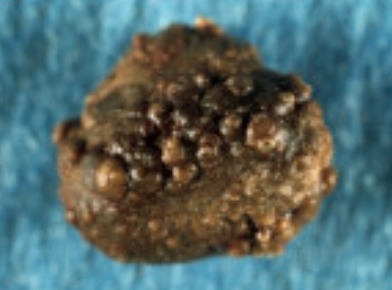
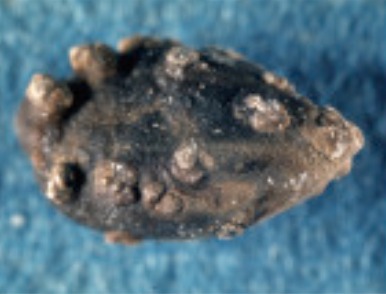
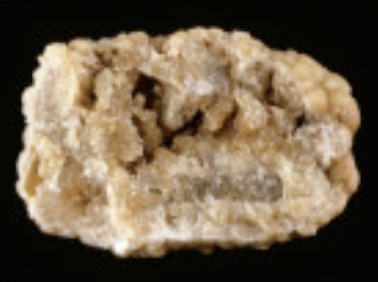
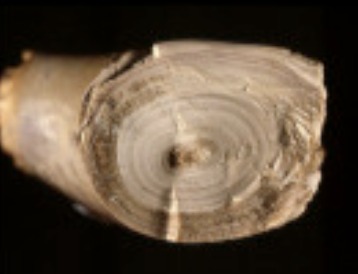
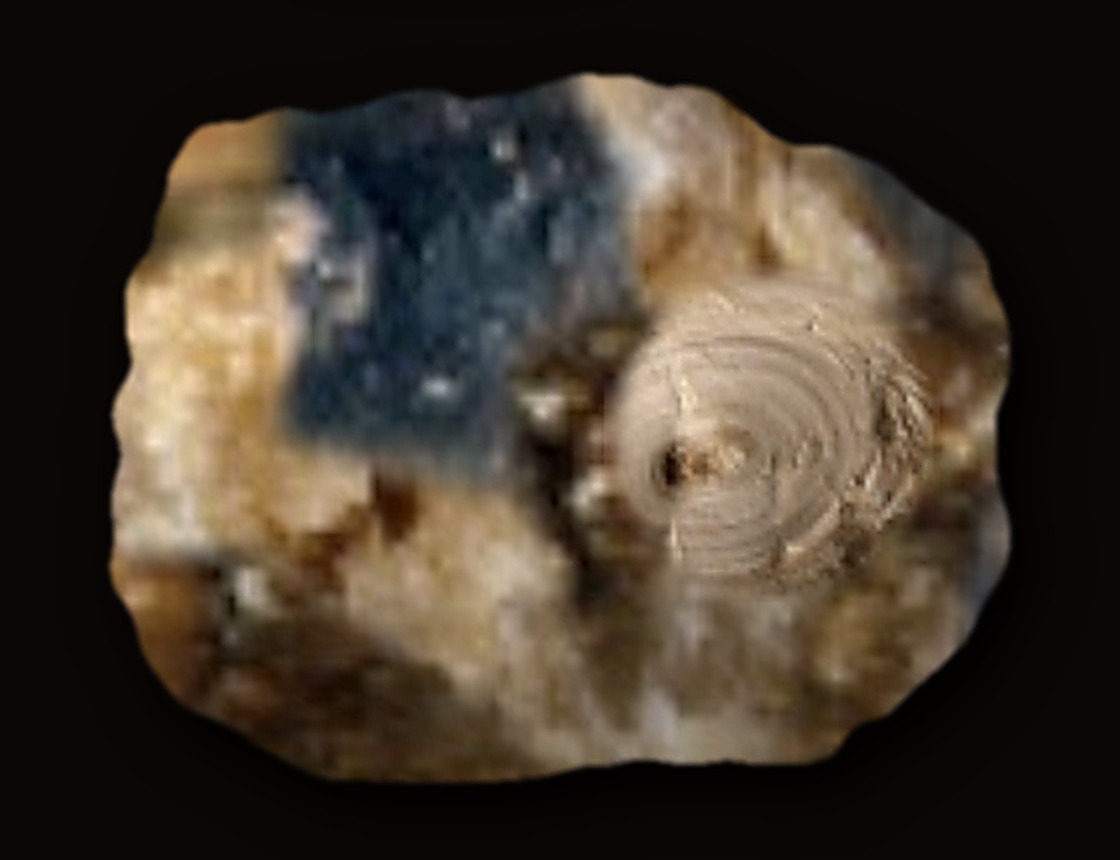
Fusion of the four: grains, nodules, crystals, dark matter and growth rings in one invented stone — heterogeneous parts perceived as one whole.
02 · MORPHOSIS Ensemble / Morphosis DUO
A flexible ensemble for mixed music
Barcelona-based ensemble for mixed electroacoustic music (instruments + electronics), dedicated to new creation. Ten years of activity celebrated in 2024.
No fixed line-up: a variable structure of performers, musicians and artists that changes shape with each project.
Creation as experimental research: very diverse projects on AI, spectromorphology, sonorous scores, new notation and new forms of staging…
Selected projects
MOZART RELOAD (2021) · CAGE RELOAD (2022) · IB: le cornu ancestrale (2022) · FLEXUS PROJECT (2023– ) · L’ESCOLTA MORFOLÒGICA (2024) · satellite groups MORPHOSIS DUO and Morphosis Clarinet Duo
In Japan
JM
Joan Martí-Frasquier
baritone & alto sax
JB
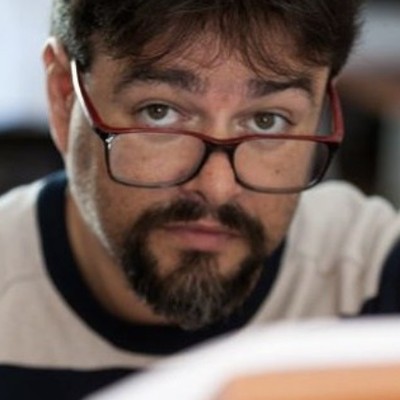
Joan Bagés i Rubí
electronics
AT
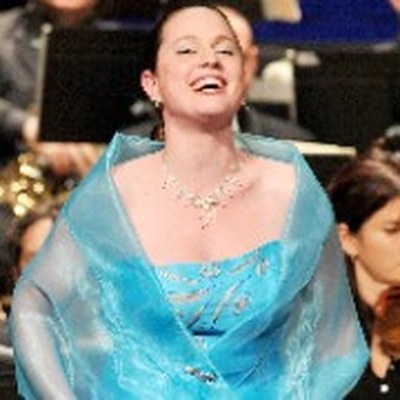
Anna Tobella
mezzo-soprano
XG
Xavier Gelabert
electronics & voice
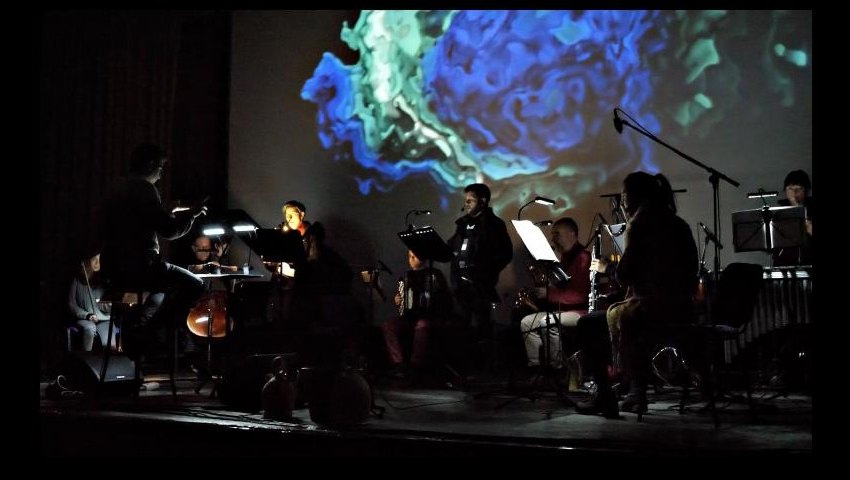
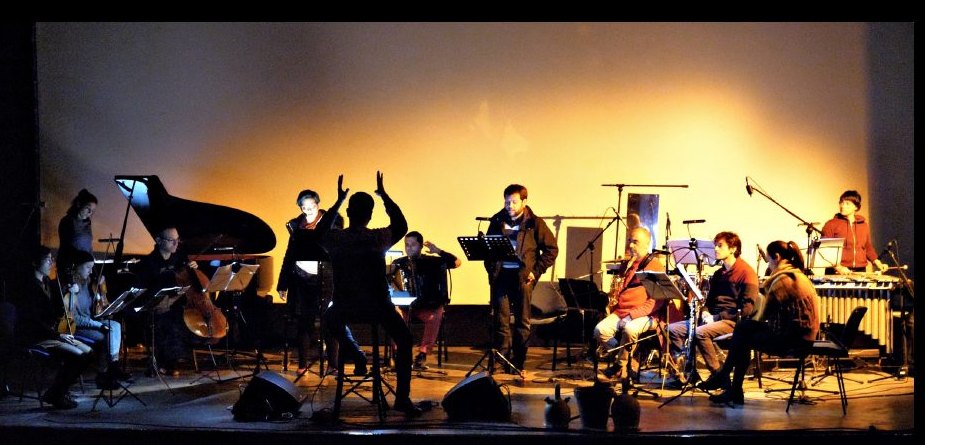
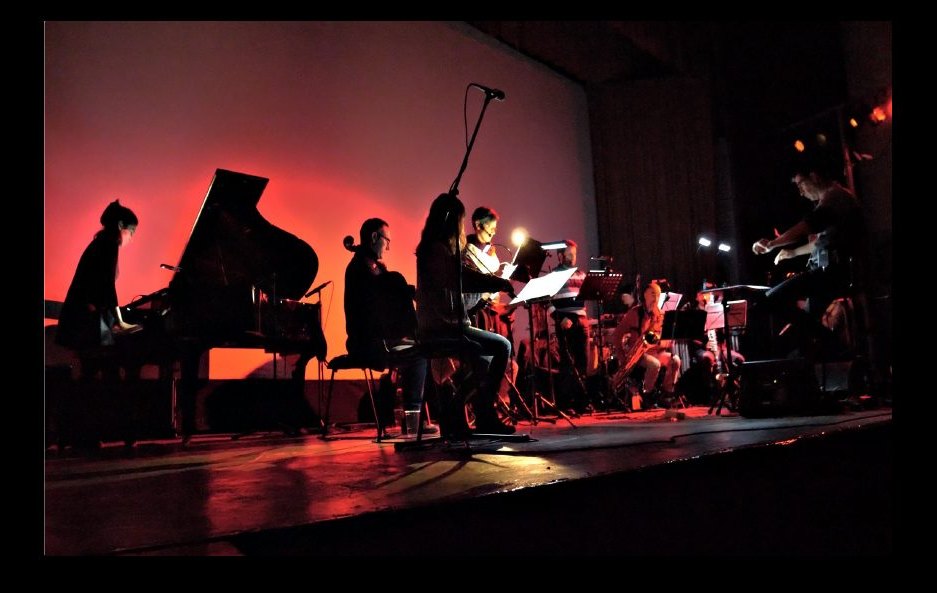
MORPHOSIS Ensemble in concert — from the IB presentation dossierIB: le cornu ancestrale, concert version
03 · FLEXUS PROJECT
An international artistic & research project
FLEXUS — Latin for “bent, flexible”: a project that adapts its format to each place, each partner and each group of students.
We build an international network between countries, and we research by creating: new works exploring new aesthetics and new approaches to sound.
Concerts, lectures, workshops and new works for mixed and electronic music, built together with local composers, performers and schools.
4th edition · 2023–2024
Göteborg (Sweden) · ESMUC, Barcelona · Tartu (Estonia)
5th edition · 2025–2026 · “Morphologies of Sound”
Japan tour with Nagoya College of Music, the Japanese Society for Electronic Music and Tokai University
Japan · September–October 2026
29 Sep
Nagoya College of Music — this lecture + masterclass with composition students
30 Sep
Nagoya — open rehearsal
1 Oct
Nagoya — concert “FLEXUS PROJECT 5th edition: Morphologies of Sound”
3 Oct
Tokyo, MONTEN — concert organised by the Japanese Society for Electronic Music: open and graphic scores
5 Oct
Tokai University — lecture-concert, improvisation with MORPHOSIS DUO, students and teachers
04
Contextual framework
From the sound object to spectromorphology and multi-layered composition
Step 1 · Pierre Schaeffer · the vocabulary
Five concepts to listen with
1 · Reduced listening
Écoute réduite: listening to the sound itself, “while abstracting it from its real or supposed cause, as well as from the meaning it might convey”.
2 · Sound object
What reduced listening perceives: a unit of sound heard for its own qualities — “the equivalent to a unit of breath or articulation, a unit of instrumental gesture”.
3 · Sound morphology
The anatomy of a single sound: the criteria that describe its form — mass, dynamics, timbre, melodic and mass profiles, grain, allure.
4 · Sound sequence
Sound objects chained in time: a succession of articulated morphologies that forms a larger unit — a gesture, a phrase, a path.
5 · Sound web · trame
A sustained texture “in ambient time with constantly changing spectrum” — a stratified sound made of many simultaneous layers.
Schaeffer himself:Étude aux chemins de fer (1948), from the Cinq études de bruits · listen online ↗
P. Schaeffer, Traité des objets musicaux (1966) · M. Chion, Guide des objets sonores (1983) · L. Thoresen, “Spectromorphological analysis of sound objects”, Organised Sound 12/2 (2007)
Step 1 · The morphological criteria
Seven ways to describe a sound
1Mass — how the sound occupies pitch space
2Dynamics — attack and envelope
3Harmonic timbre — colour around the mass
4Melodic profile — how the mass moves in pitch
5Mass profile — how the mass itself changes
6Grain — micro-texture of the surface
7Allure — the “gait”: vibrato, tremolo, oscillation
In my work the first criterion — mass — becomes a compositional axis.
Mass: son pur → tonique → groupe tonique → cannelé → groupe nodal → nœud → frangeGrain
CLASSES OF MASS
MASS · SPECIES
Schaeffer's effort
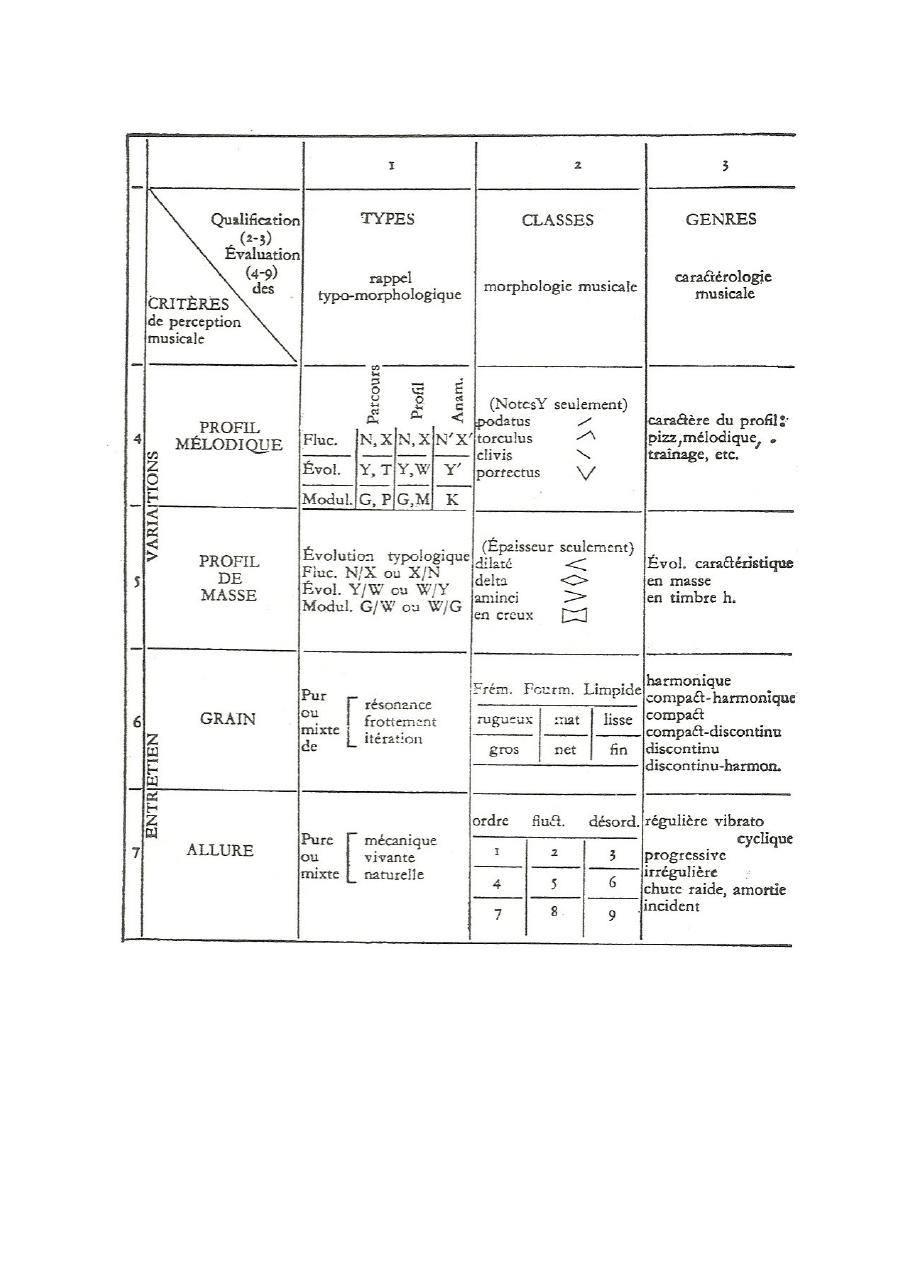
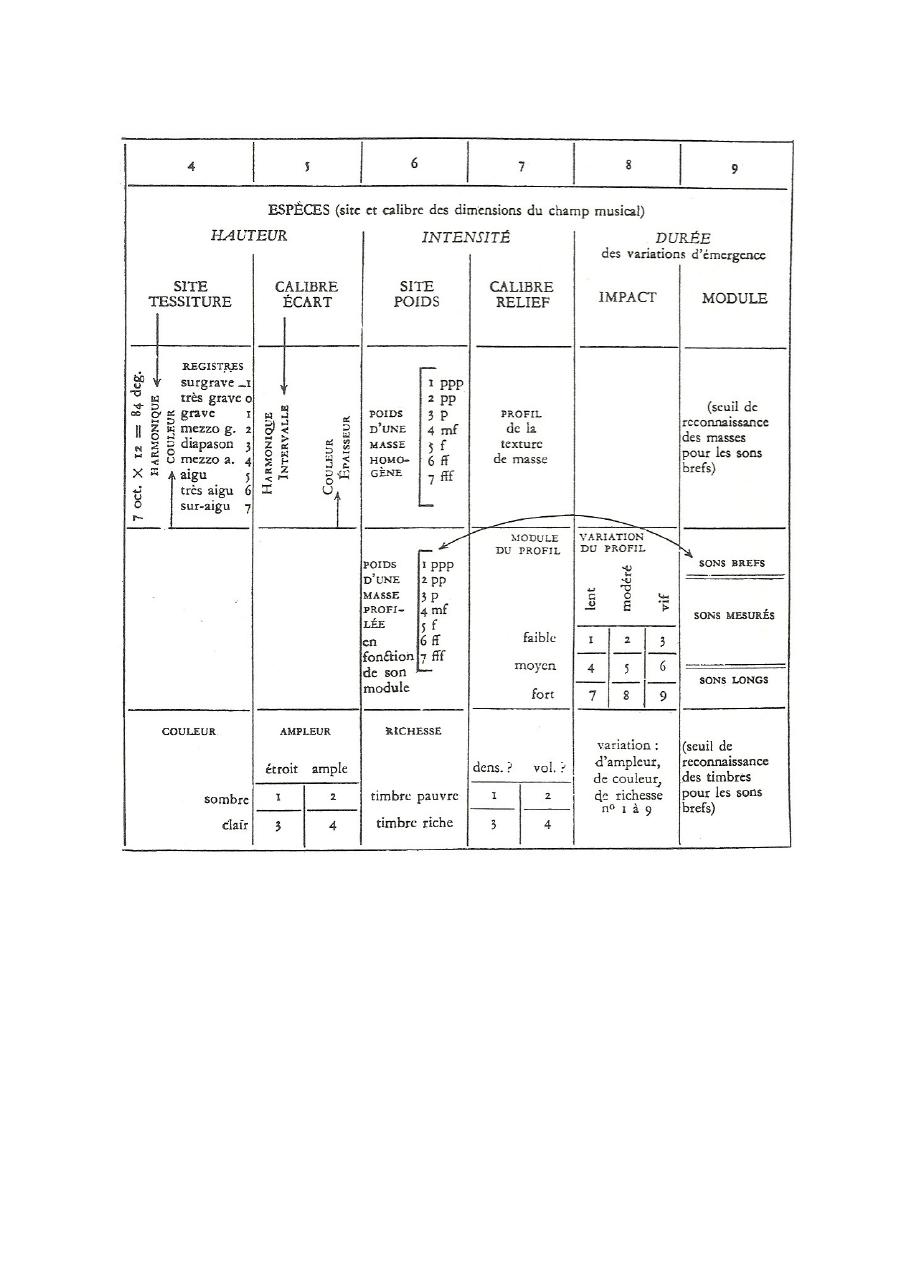
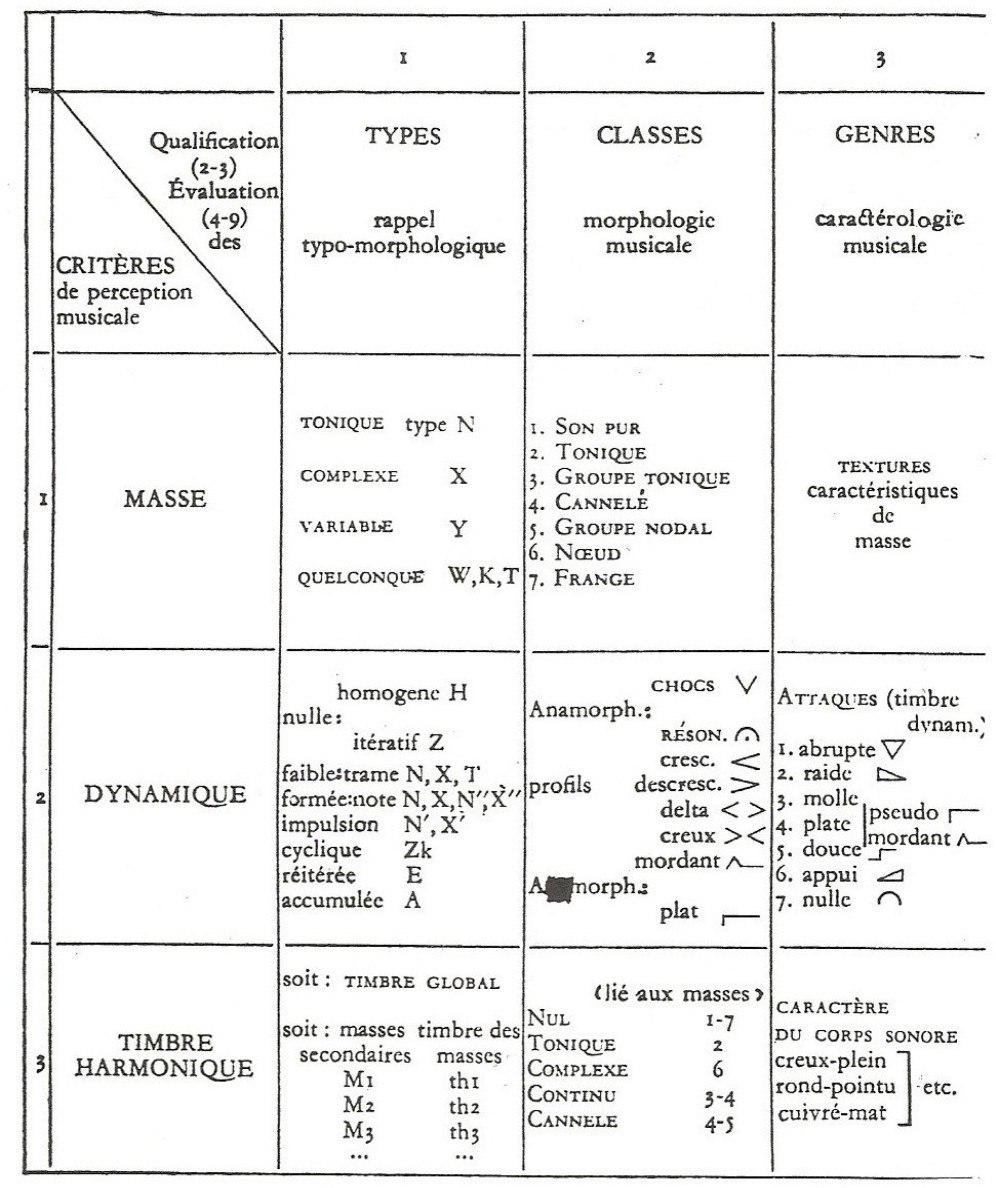
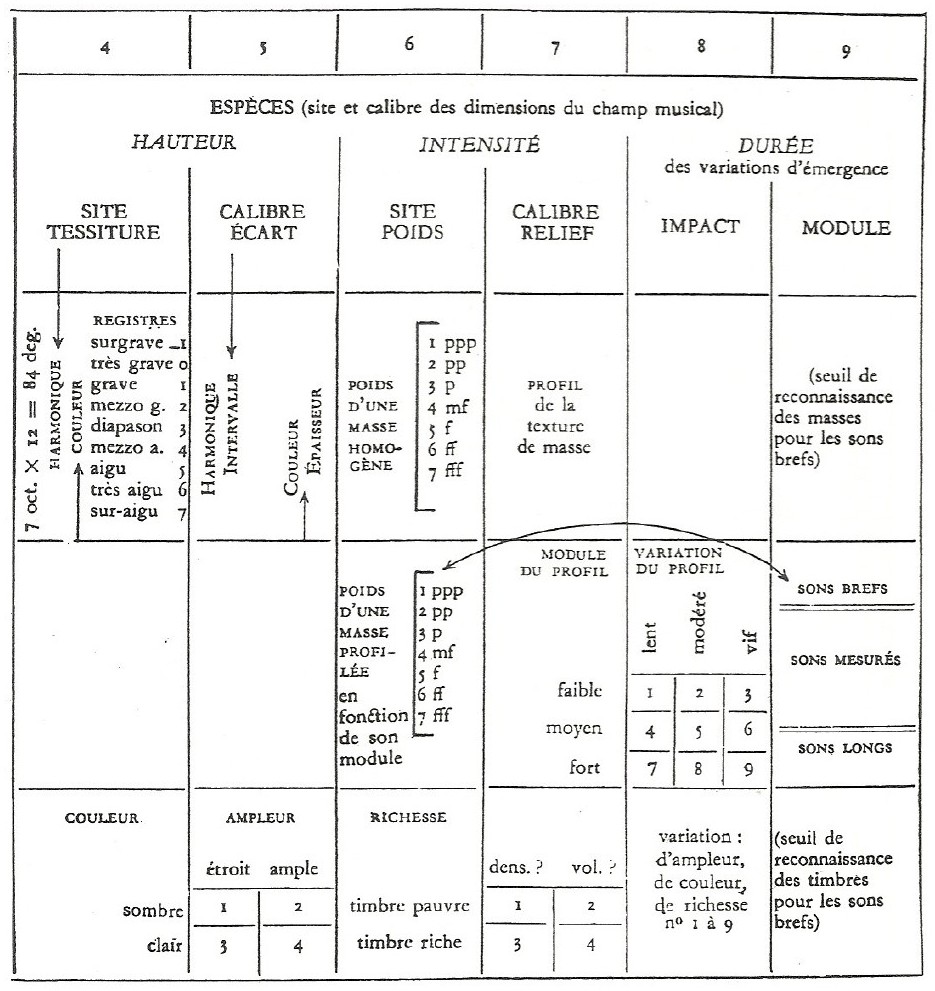
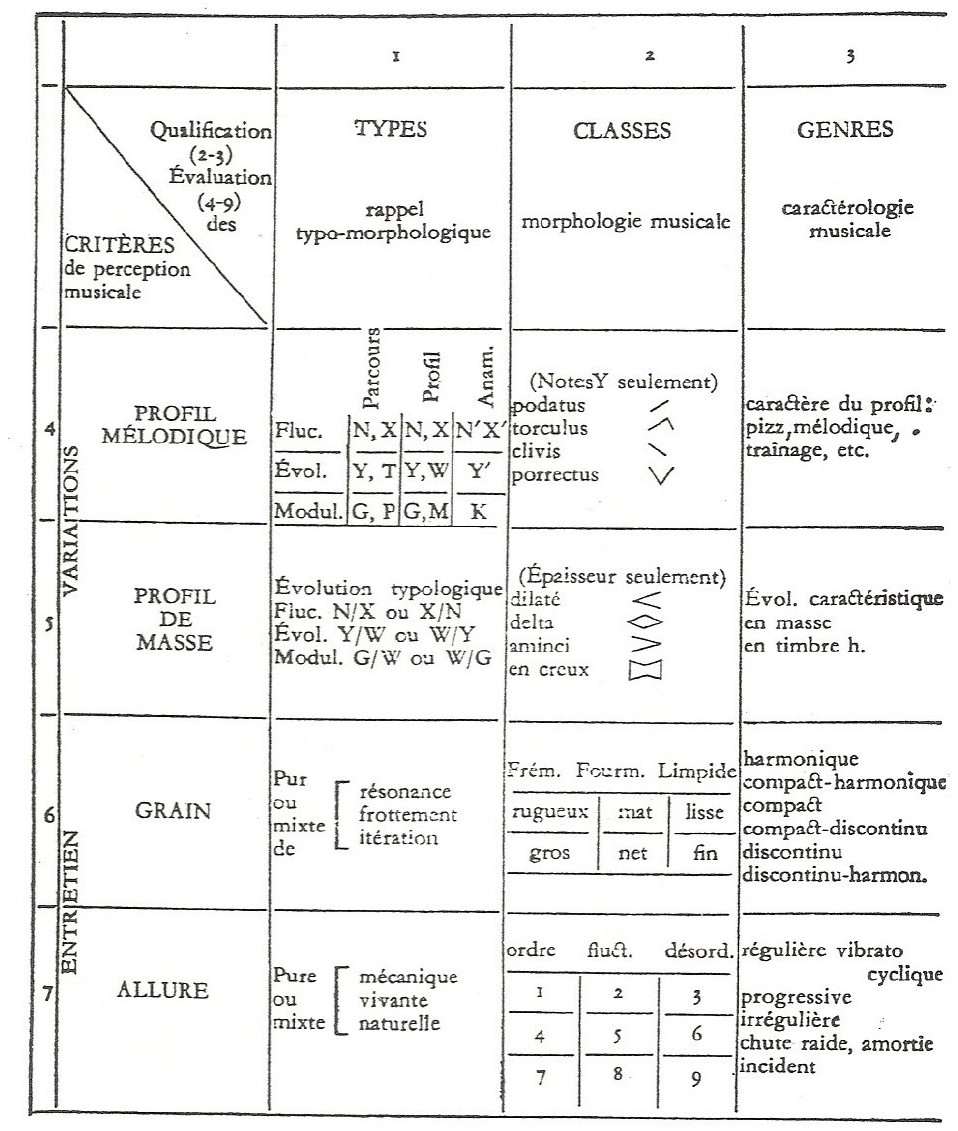
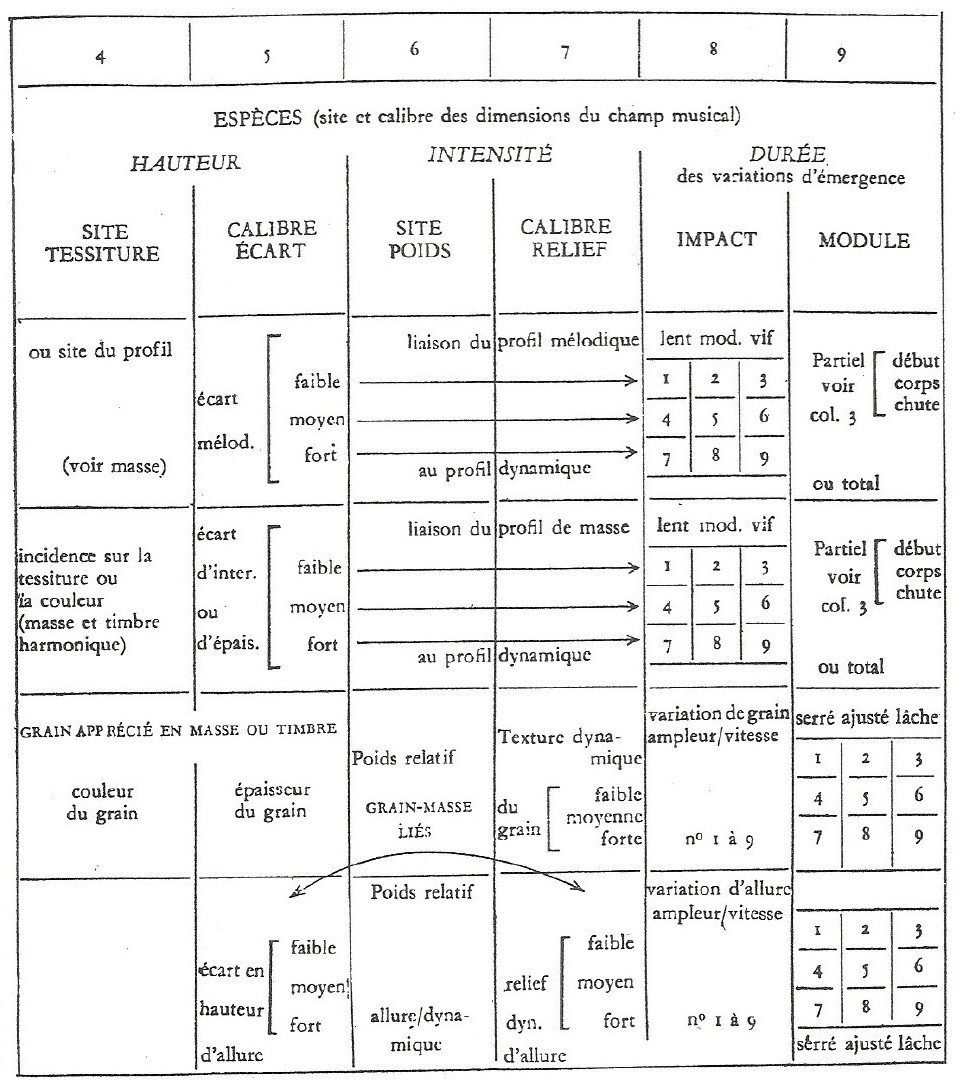
From the first études de bruits (1948) to the Traité (1966): almost twenty years of studio research to build a solfège for all sounds — a way to describe any sound by what we hear, not by its source or its notation. First sort (typology), then describe (morphology), with 7 criteria × levels of description. This table (TARSOM) is the synthesis.
The 7 classes of mass
1 Son pur — no harmonics: a sine-like sound
2 Tonique — one fixed, recognisable pitch: the note
3 Groupe tonique — several tonic sounds heard together: a chord
4 Cannelé — tonic and nodal at once: a pitch emerging from a noisy band
5 Groupe nodal — several nodal sounds: pitch regions heard together
6 Nœud — a pitch region, not a note
7 Frange — a band of noise, coloured by register
From the note to the noise: the axis of all my scores.
P. Schaeffer, Traité des objets musicaux (1966): Tableau récapitulatif du solfège des objets musicaux · columns 1–3: types, classes, genres · columns 4–9: species (pitch, intensity, duration) · click to zoom
Mass: son pur → tonique → groupe tonique → cannelé → groupe nodal → nœud → frangeGrain
GRAIN
GRAIN · SPECIES
Rows 4–5: variations (melodic profile, mass profile) · rows 6–7: entretien, sustainment (grain, allure) · click to zoom
Step 1 · Listening · the classes of mass
From the pure sound to the fringe
Pure sound son pur
A sound without harmonics: a sine wave.
Tonic sound son tonique
A fixed, recognisable pitch — the “note”.
Fluted / rippled son cannelé
A tonic sound with internal movement: vibrato, tremolo, frullato.
Nodal group groupe nodal
Groups of sounds whose final pitch is hard to identify.
Node nœud / son nodal
A sound with a pitch “region” but no clear note.
Fringe son frange
Air, friction, distortion: a rich band of noise we can colour.
Pure sound: electronic sine wave · other recordings: French horn, Duo Atem — morphological sound bank of Cicada Killer (2024–26). Spectrograms: logarithmic frequency.
Step 1c · Grain · the granularity of sound matter
Sound as particles
Perception. For Schaeffer the grain is the micro-texture of a sound’s surface — frémissement, fourmillement; rugueux, mat, lisse. We do not hear the single events: we hear a texture with a density, a size and a colour of grain.
Granular synthesis. Sound built from thousands of tiny grains of about 1–100 ms. Gabor (1947): sound as “acoustic quanta”. Xenakis: “all sound… is conceived as an assemblage of a large number of elementary sounds” (Analogique A-B, 1959). Roads: first computer implementation (1974), Microsound (2001). Truax: real time (1986).
My influences
Horacio Vaggione (Córdoba, 1943 · Université Paris 8, my DEA supervisor): micro-time, object-based composition across time scales — Schall (1995). José Manuel Berenguer (Barcelona, 1955 · Orquestra del Caos, my teacher in Barcelona): the studio as a laboratory of sound matter. José Manuel López López (Madrid, 1956 · Université Paris 8, my composition teacher): “the scientific and philosophical nature of sound” — time, spectrum and electronics in the instrumental writing.
In my music · grain and granular synthesis
1 · acoustic grain, amplified
2 · real-time granulation of the instruments
3 · a granular cloud
From the acoustic grain of the instrument to the synthetic grain of the electronics: the same morphology at two scales — which is why they fuse.
Step 1b · Rebecca Saunders · the sound palette
A palette of sounds
“From this sound, I created what I call a palette of sounds. If you imagine a painter… he will have his palette of colours.”
A very reduced palette “shaved carefully off the potential sound mass of the ensemble”, each sound “carefully balanced with the surrounding silence” — sounds “that meet the borders of noise and of silence”.
The palette is built with the performers, close to “the physical reality of the instruments’ core sounds”: “the weight of the bow on the string; the differentiation of touch of the finger on the piano key”.
Rebecca Saunders (London, 1967 · lives in Berlin) · studied with Wolfgang Rihm · Ernst von Siemens Music Prize 2019 · my composition teacher in Berlin
How one sound is built · its morphological mechanics (schematic)
“A single tone with different bow speeds, from half a second to 32 seconds, consequently varying bow pressure and speed, focusing in on varying overtone spectrums” — every parameter is notated, often with detailed text annotations.
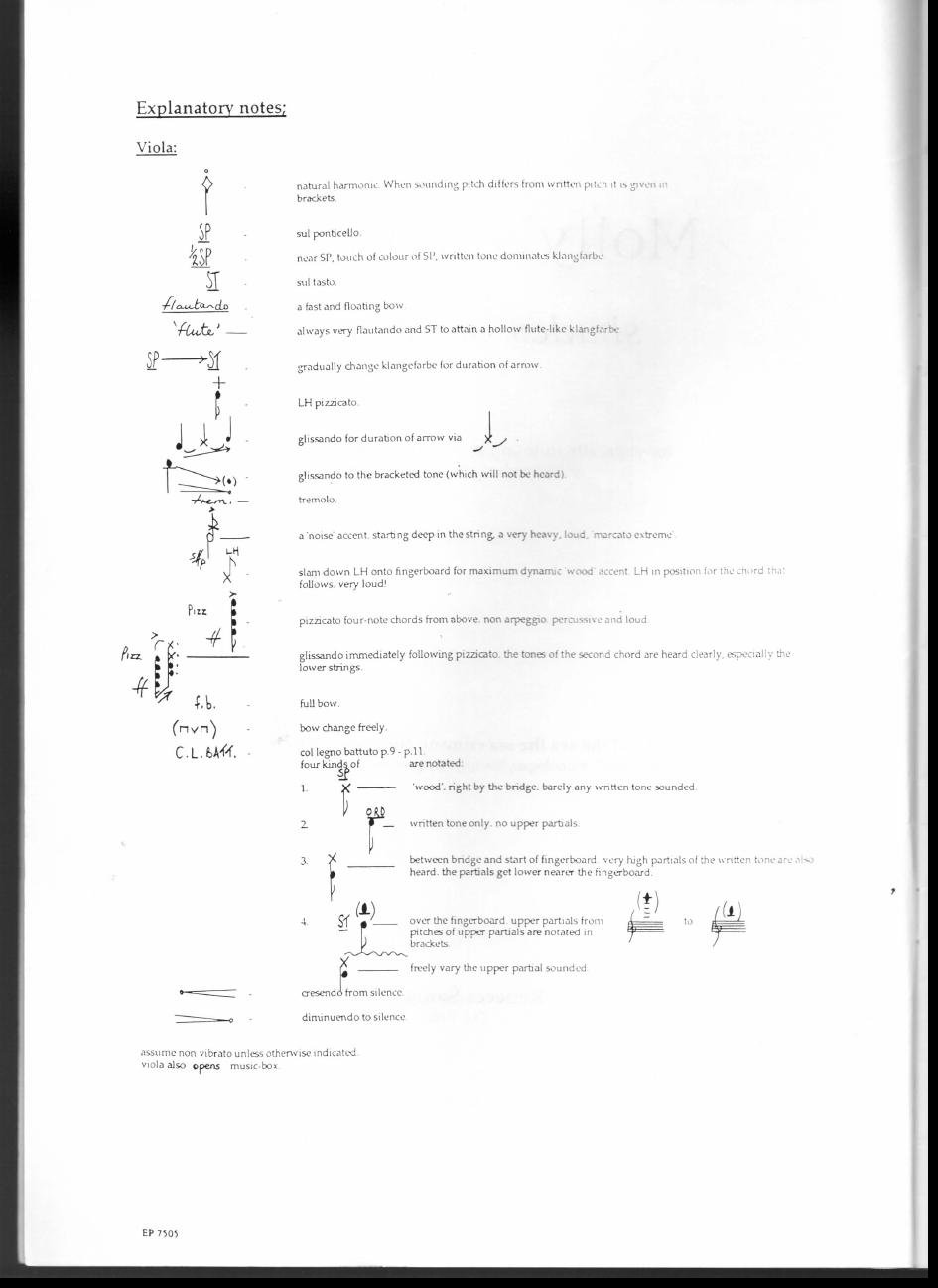
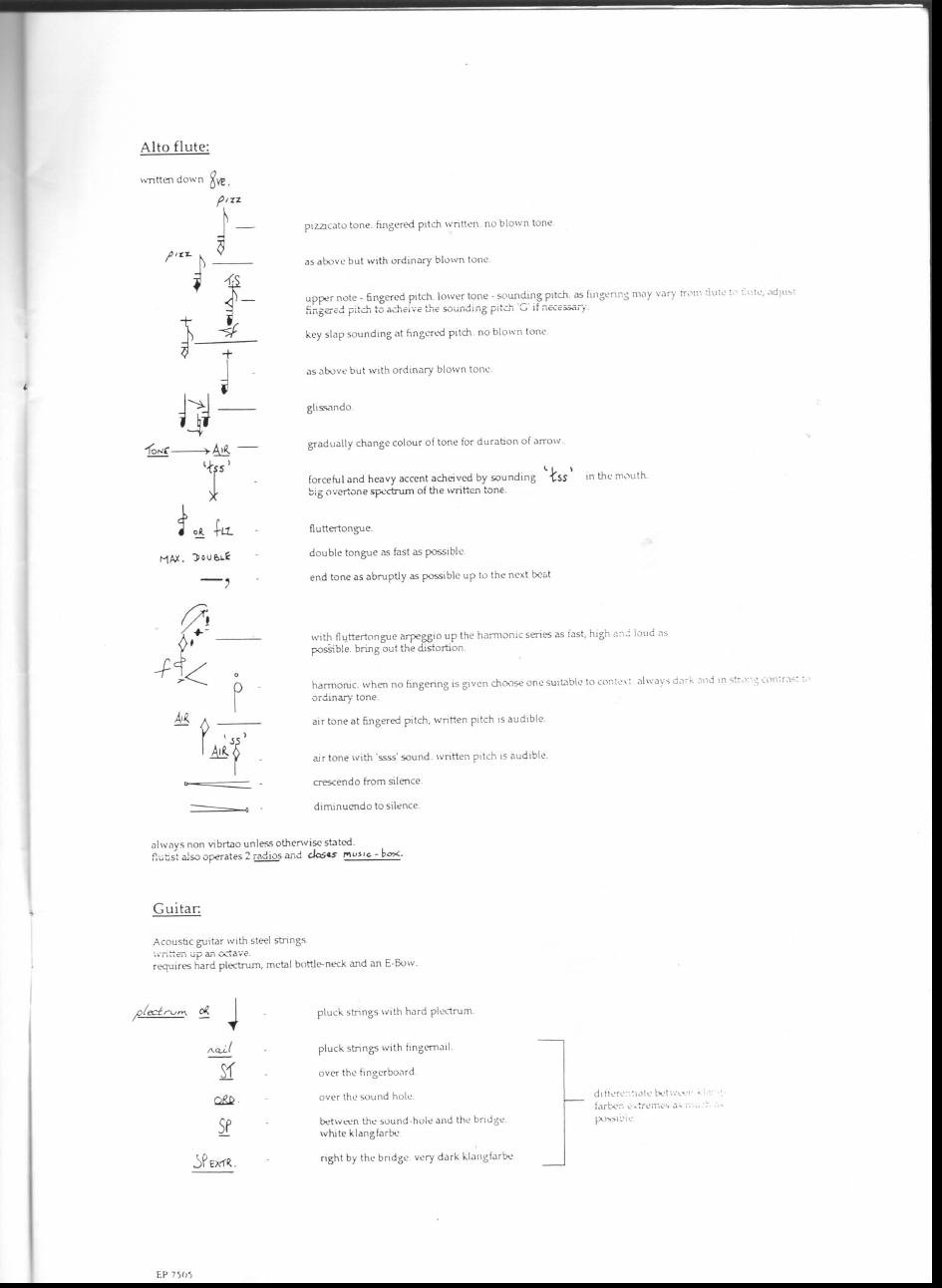
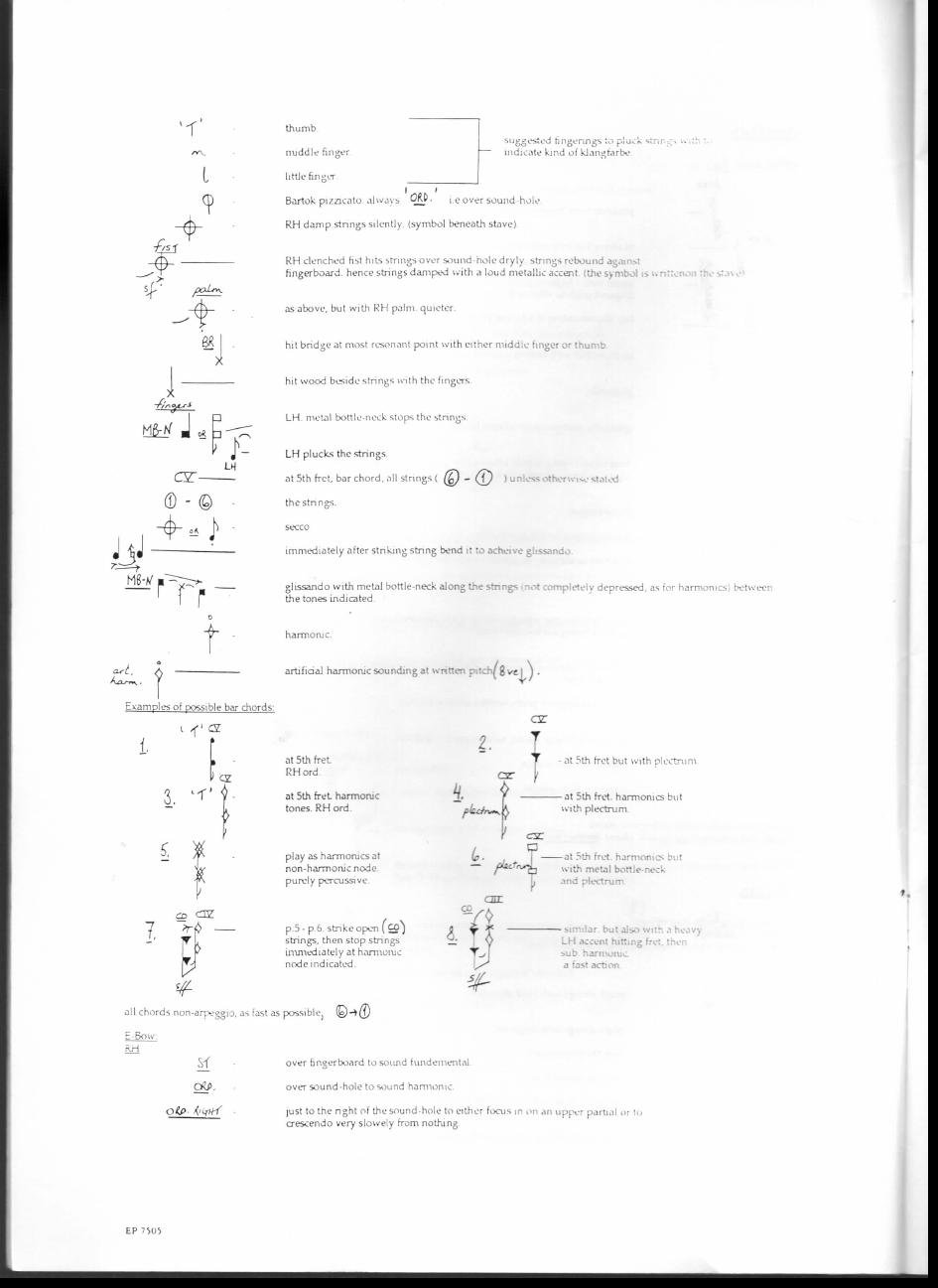
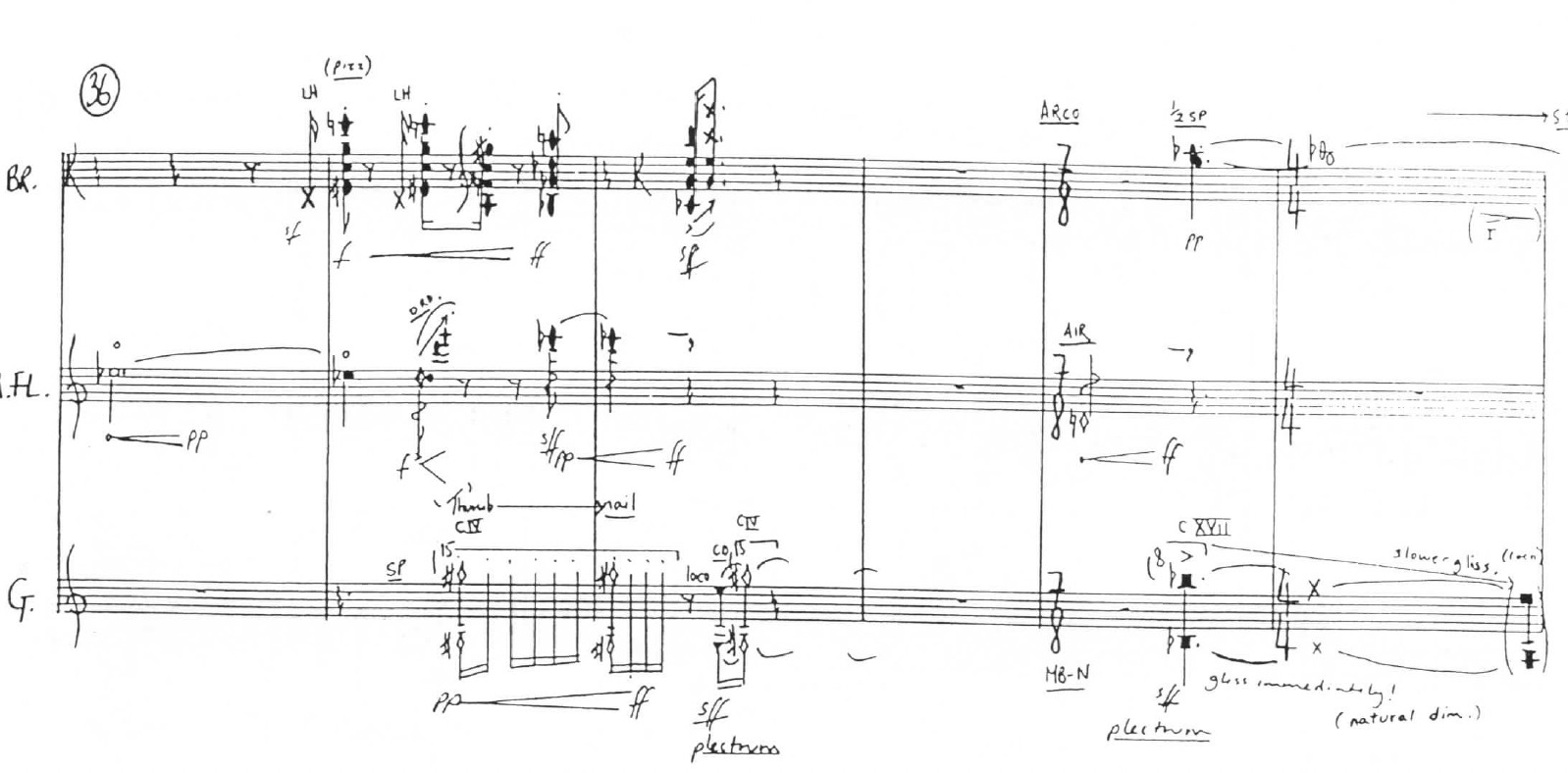
One pitch, many sounds · Fury II (2009–10), mm. 35–40
Explanatory notes (viola · alto flute · guitar): every sound of the palette has its own symbol and instruction. Click to read.
Rehearsal 36 · how each sound is built
Three instruments, one sound object that transforms: A (1·3·4·6·7), then B (2·5·8).
1Viola · LH slam + pizz chords “slam down LH onto fingerboard for maximum dynamic ‘wood’ accent” · pizzicato four-note chords “from above, non arpeggio, percussive and loud”, then glissando f → ff → sff
2Viola · arco ½SP, pp “near SP, touch of colour of SP, written tone dominates klangfarbe” — then a slow move towards sul tasto
3Alto flute · harmonic from silence harmonic, “always dark and in strong contrast to ordinary tone” · crescendo from silence to pp
4Alto flute · fluttertongue arpeggio + key slaps “with fluttertongue arpeggio up the harmonic series as fast, high and loud as possible. Bring out the distortion” · key slaps sff
5Alto flute · AIR “air tone at fingered pitch, written pitch is audible” · crescendo to ff
6Guitar · SP, thumb → nail between sound-hole and bridge (“white klangfarbe”) · harmonics, bar chord at 4th fret · the finger changes the colour: thumb → nail, pp → ff
7Guitar · plectrum chord hard plectrum, sff: an attack that closes the gesture
8Guitar · metal bottle-neck MB-N, chord at 17th fret with plectrum sff · “gliss immediately!” (natural dim.) · then slower gliss
“The synthesis of simultaneous sound streams into a coherent whole with internal components and focal points.”
Greek holos (whole) + phōnē (sound). Not the acoustic “holophony” of holography: a musical texture.
Historical concept
A new stage in the history of texture, after monophony, polyphony and homophony — emerging from around 1950 with Xenakis (Pithoprakta, 1955–56) and Ligeti’s micropolyphony. It rests on perception: Schaeffer’s sound object, Risset’s spectral fusion, McAdams’ fusion/fission, Bregman’s auditory streams.
Current concept · in his music
“Each independent sound (φωνή) contributes equally into the synthesis of the total (ὅλος)” — a virtuosity of sound. In Holophony for string quartet (2002–03) the result is “a single abstract sound with internal components and with focal points”.
Articles
“Towards a Holophonic Musical Texture”, ICMC Barcelona (2005) · Journal of Music and Meaning (2007) “Auditory fusion and holophonic musical texture in Xenakis’ Pithoprakta”, ICMC Athens (2014) “Morphopoiesis: a general procedure for structuring form” (2005)
Heterogeneous morphologies are composed in layers — acoustic, amplified, electronic, spatial, visual — which are perceived together as one sound: holophony.
The mixture of acoustic and electronic sound opens an unusual timbral and morphological richness: the instrument extends into the electronics, the electronics take on the body of the instrument.
The challenge
To compose the interactions between the layers — and how they evolve in time.
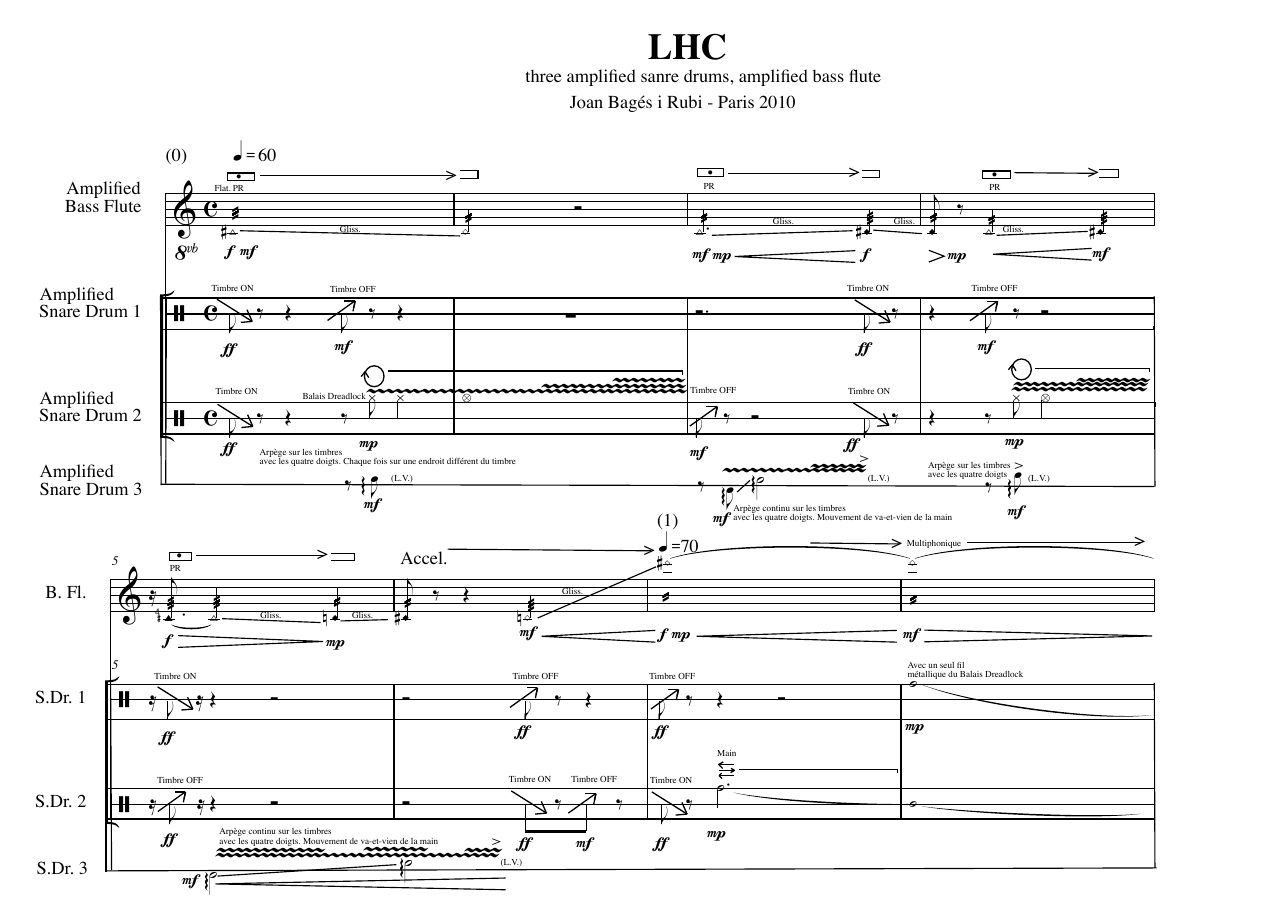
A · LHC · amplified bass flute & three amplified snare drums · Paris 2010
Collision creates matter
LHC = the Large Hadron Collider in Switzerland, built to study the origin of matter. The piece “creates and accelerates matter and particles”.
The collision of two realities — the raw sound of the bass flute and the percussion — generates figures, lines, accumulations.
A work built on a sound palette and on the morphology of grain: brushes, nails and fingers on granular drum heads, frullato and jeu voilé on the flute — an analogue granular synthesis, made by hand.
“The most important thing is a balance where the sum of the two instruments generates a new instrument, heard through the loudspeakers.”
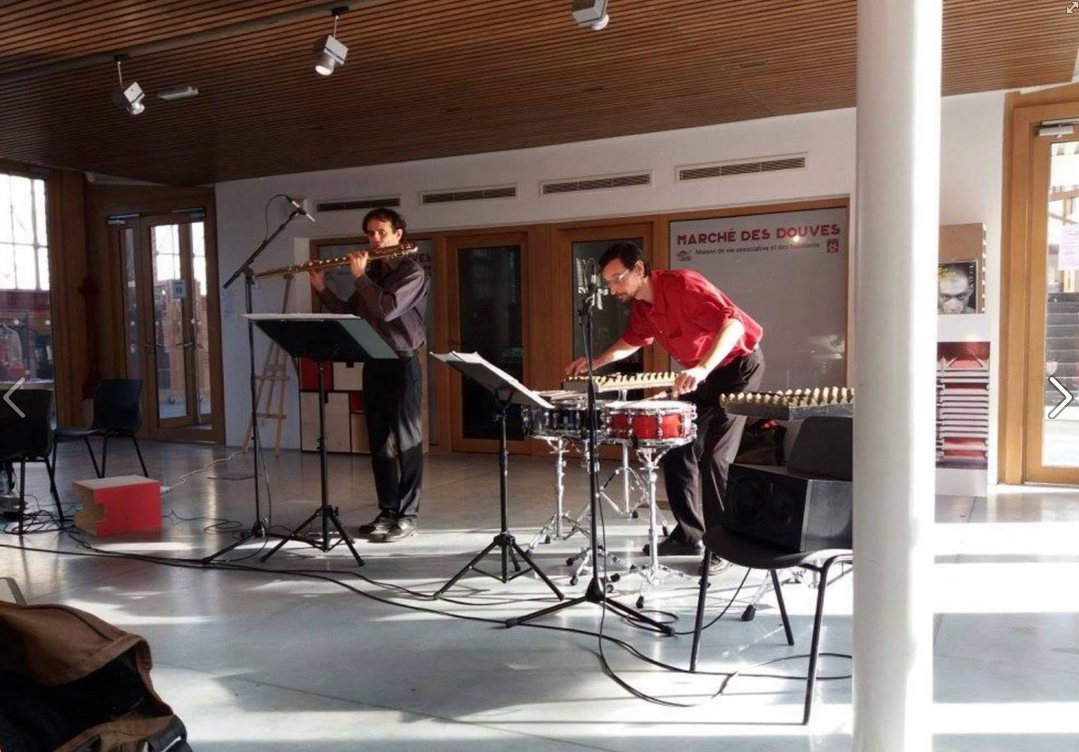
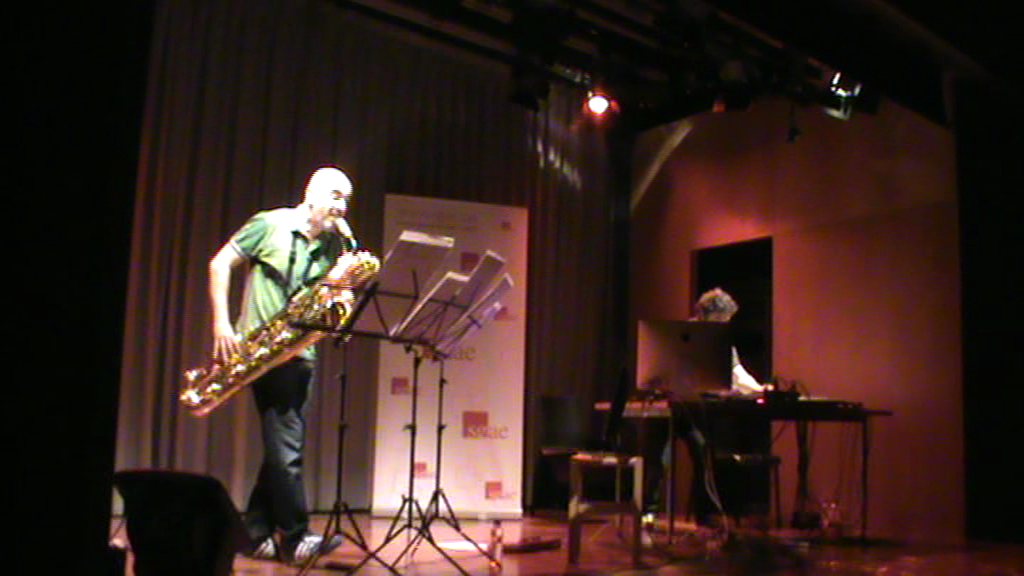
LHC in performance — bass flute and three snare drums
Amplification as a sound microscope
The only electronics is amplification — two stereo positions + the centre. It enlarges the grain like a microscope, and the fusion happens in the loudspeakers: holophony without a computer.
SD1 piccolo and SD2 large, both with granular heads, divided into 9 zones (1 = upper rim · 5 = centre · 9 = lower rim). SD3 upside down: played on the snares.
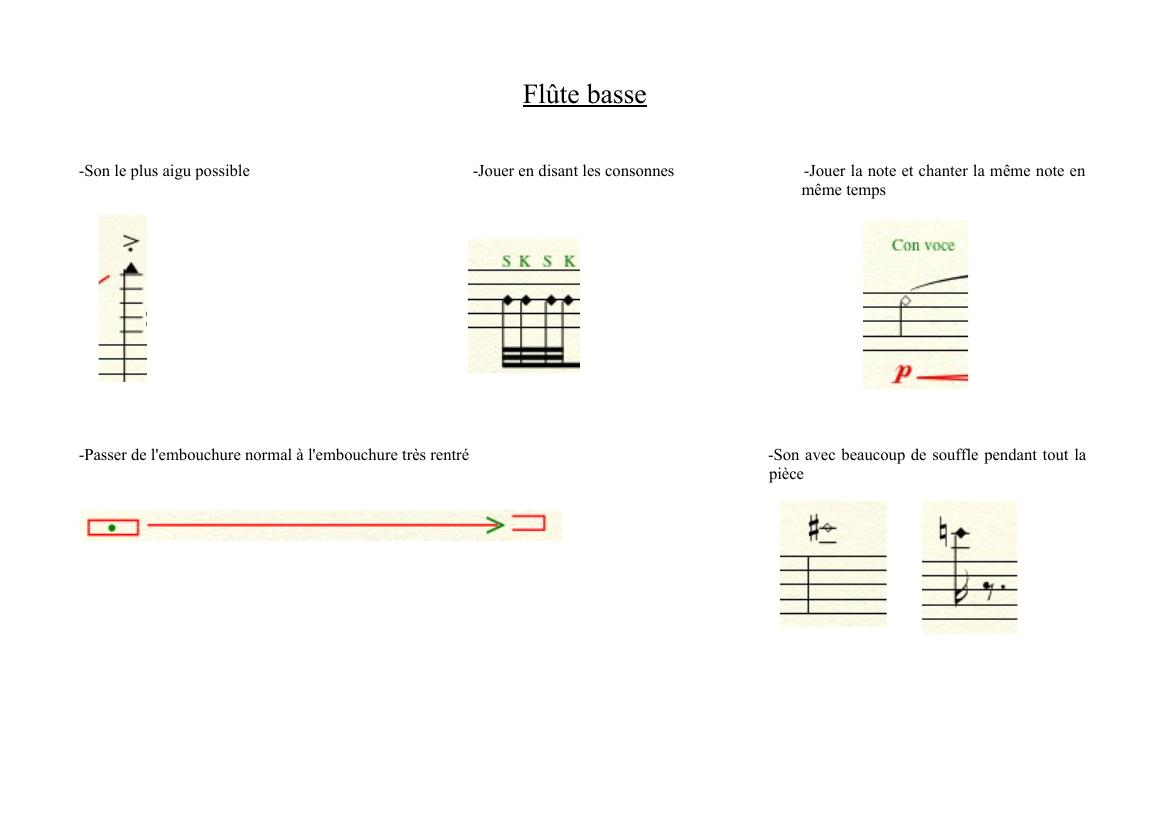
Highest possible sound · speaking consonants (SK, PR) · singing and playing · frullato · jeu voilé · richest multiphonic · slap · long gliss.
Legend for the bass flute (from the performance notes)
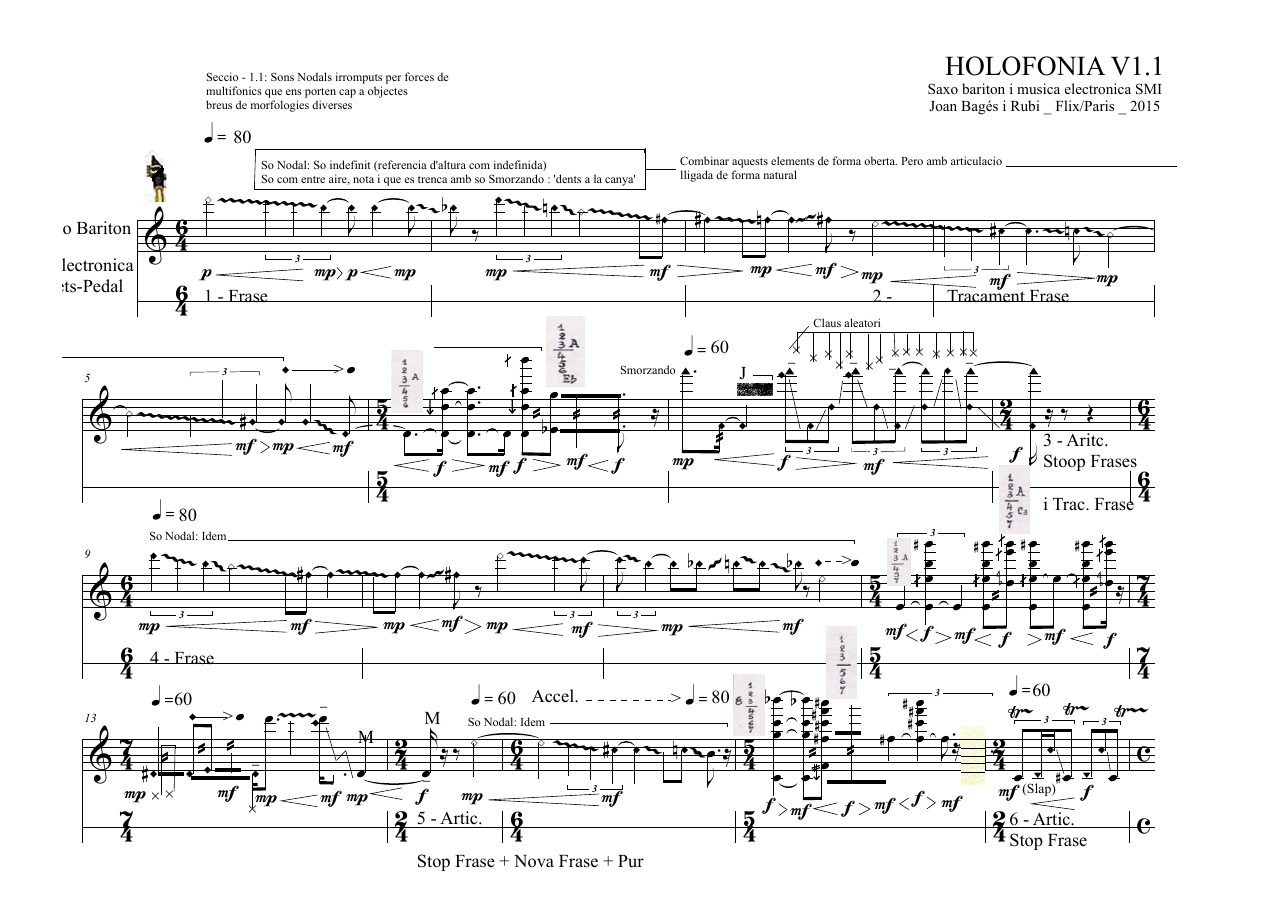
A · HOLOFONIA v1 · baritone saxophone & electronics (SMI) · Flix/Paris 2015 · for Joan Martí-Frasquier · ≈10′
A microscope for the ear
The contrast between the large, dense and loud (the exterior, the super-structure) and the infinitely small: microscopic life that resists, fragile and unstable.
The saxophonist places tiny sounds and gestures in front of the audience “as if through a microscope”.
Amplification as a sound microscope: the contact microphone enlarges key clicks, friction and pads until they become musical material — “not anecdotal nor theatrical, but musical”.
“HOLOFONIA is a concept that refers to the construction of a global, unitary sound, based on disparate and opposed morphologies which function as a WHOLE.”
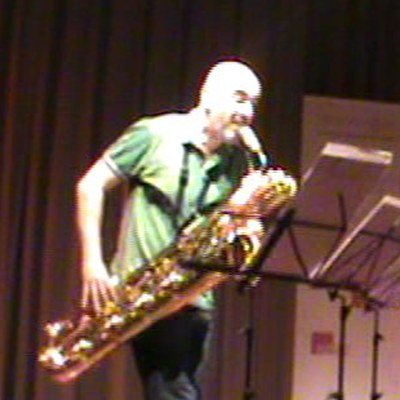
Joan Martí-Frasquier (baritone sax) and Joan Bagés (electronics)
Set-up
DPA microphone in the bell · contact microphone on the body (keys, friction, pads) · Max/MSP Interactive Musical System (SMI) · MIDI pedal to trigger presets · stereo or quadraphonic
A · HOLOFONIA v1 · the sound palette
Small sounds, treated musically
“These sounds are not anecdotal nor theatrical, but musical: it is a sonic microscope, and they must sound at a more than reasonable volume.”
key clicks — closing and opening, low / middle / high keys
finger dragged on a key: a creaking door → a nodal sound
pads slowly unstuck: a “velcro” sound
slaps (percussive, with air), kisses on the reed, teeth on the reed
eolian sounds, so nodal: “between air, note and breaking”
multiphonics (D. Kientzy fingerings) and filtered vowels in the crook
Listen · contact microphone: finger dragged on the keys
The electronic part = four banks of saxophone sounds
A
Articulations
F
Phrases
P
Percussive
N
Notes / sustained frequency
Recorded with saxophonist Joshua Hyde from my own pieces, plus an improvisation by Mats Gustafsson recorded in Flix.
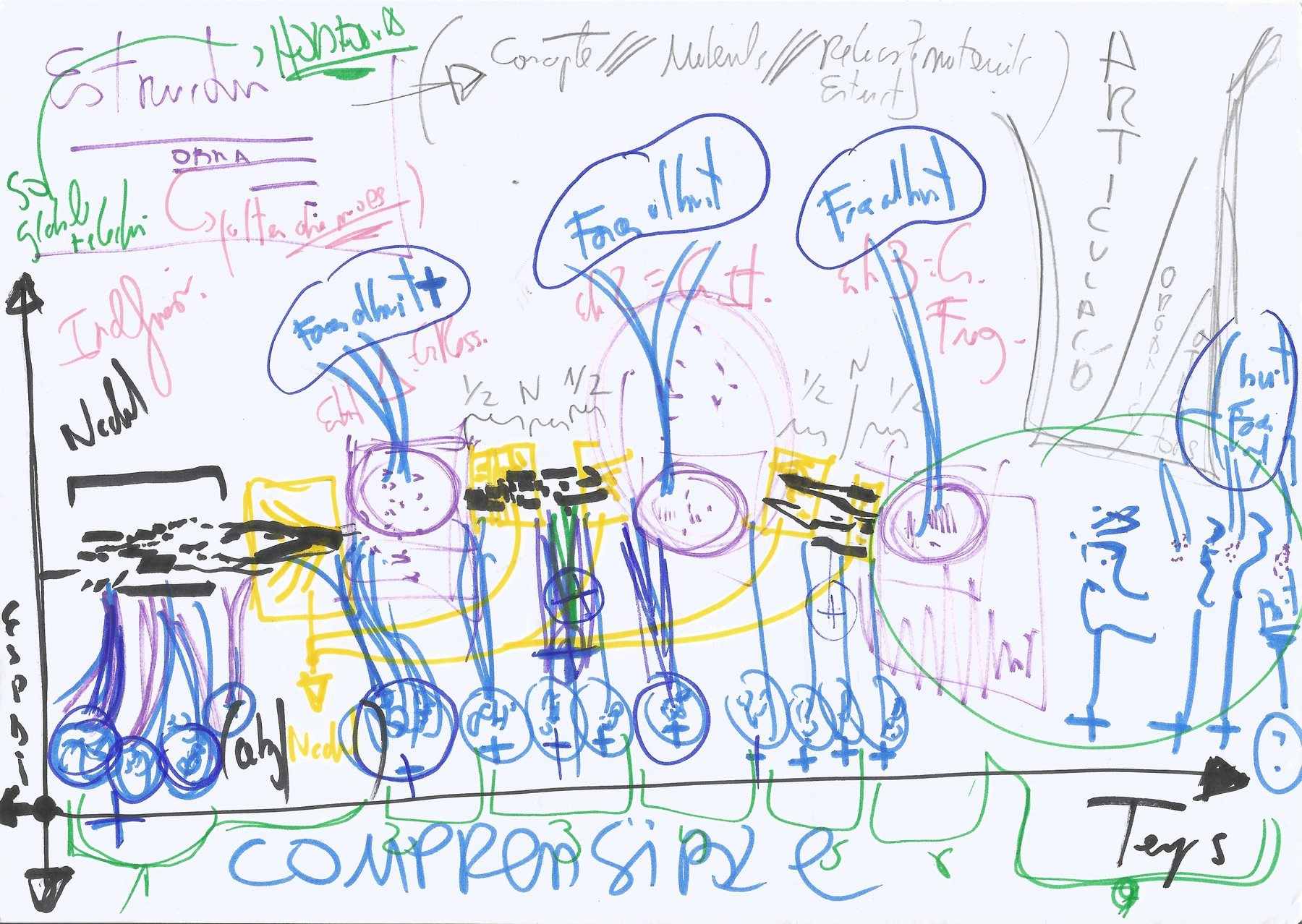
A · HOLOFONIA v1 · compositional process: structure & matter
Structure sketch — morphologies (nodal, tonic, articulations) on a time axis; “compression”
6 sections · the morphologies appear and mix over time. The embouchure is removed and replaced many times: a difficult, permanent change of state.
Click to zoom · “So nodal: indefinite sound, between air, note and breaking, with smorzando: teeth on the reed”
A · HOLOFONIA v1.1 · listening · Joan Martí-Frasquier, baritone saxophone
One sound, many morphologies
Listen for
When do you stop hearing “saxophone + electronics” and start hearing one sound?
Look at
The spectrogram: vertical columns = attacks and key clicks; horizontal lines = tonic sounds; clouds = nodal and frange.
Suggested excerpts
Opening (0:00–0:50) · 1:45–2:40 · 8:20–9:10 · click the markers or the spectrogram to jump.
A · IB: LE CORNU ANCESTRALE · electroacoustic opera in concert format · MORPHOSIS Ensemble · 2022
Water as a metaphor of existence
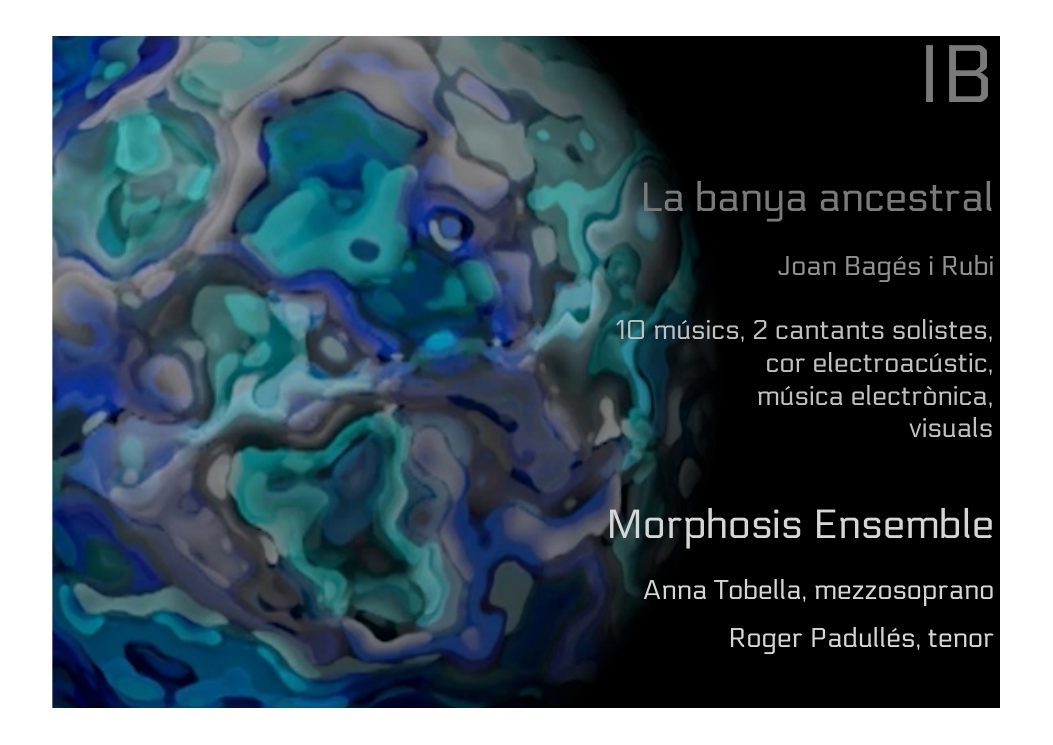
10 musicians, 2 soloists (Anna Tobella, mezzo-soprano · Roger Padullés, tenor), electroacoustic choir, electronic music and visuals · conductor Àlex Sansó.
“Opera” in its etymological sense — opus, a musical work — without theatrical representation: sound and image take the space, including the audience, surrounded by an acousmonium (orchestra of loudspeakers).
Six mental landscapes, from the question where do we come from? to death and the return to the whole. Two characters, H and O — together, the drop of water.
IB: a syllable at the origin of many Iberian words — the whole, the origin, the drop of water.
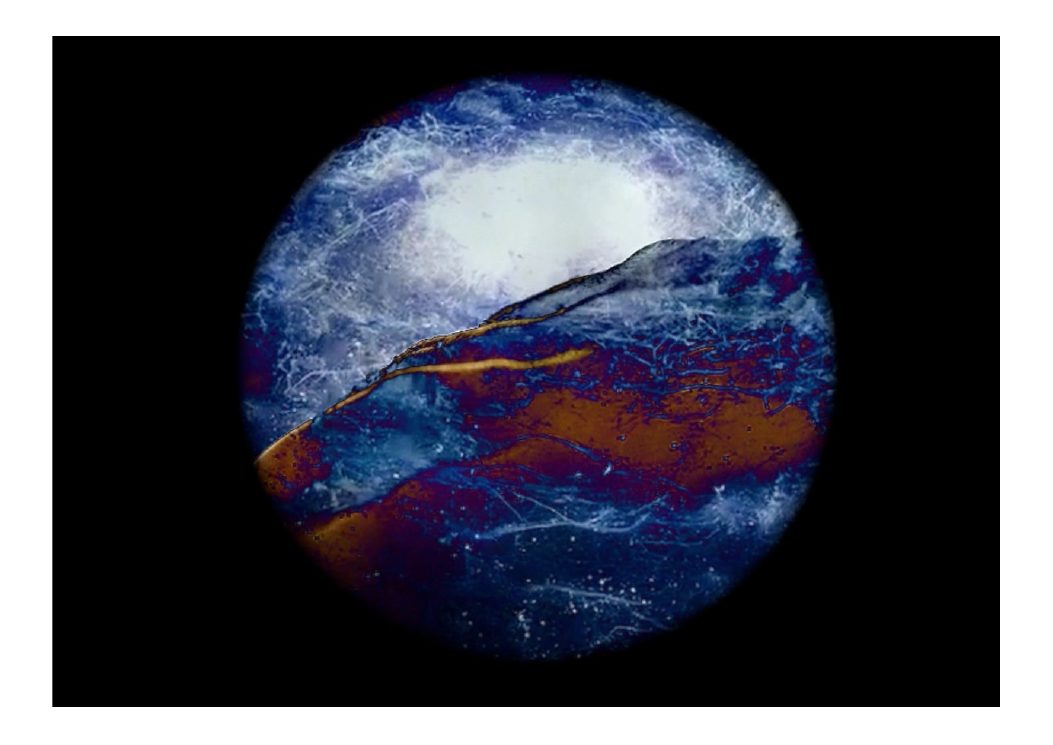
IB · posterVisuals (Belén Oniesta, after Jaume Rocamora)Concert with projectionsVisual material of the opera
Listen · spectromorphological composition in differentiated layers (online)
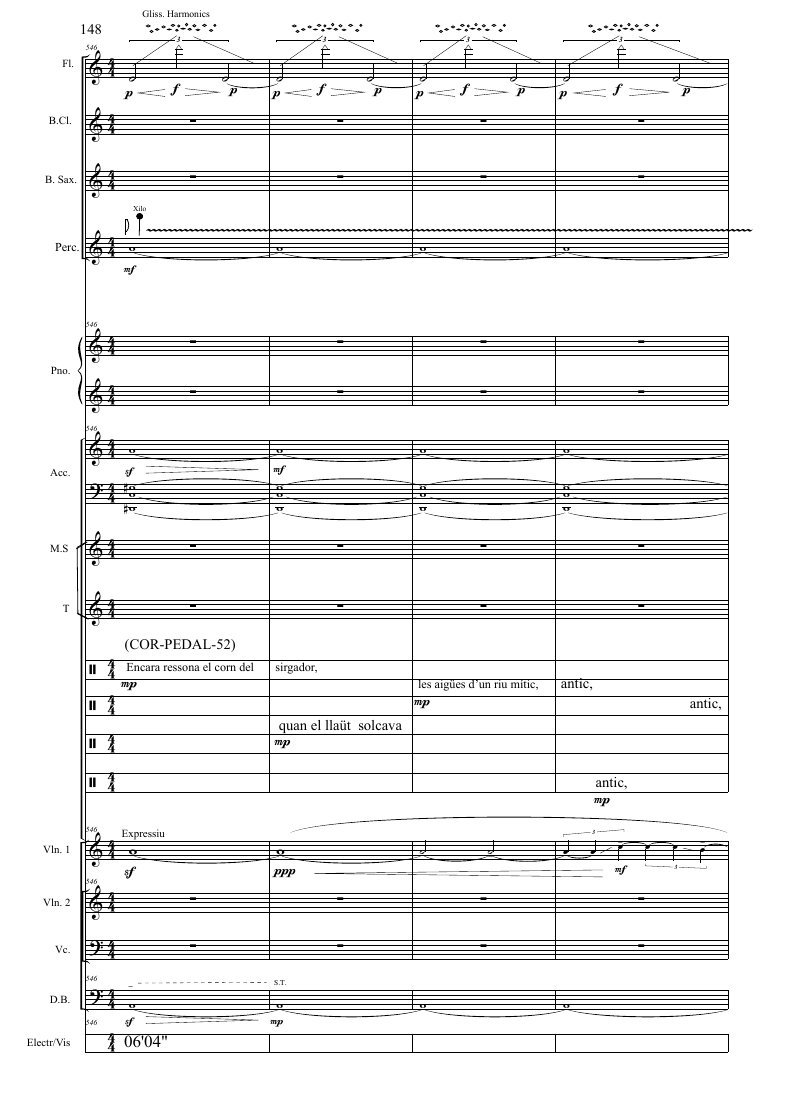
Electroacoustic choir — spoken text “Encara ressona el corn del sirgador…” mp — a thin voiced layer
Violin 1 — expressive line ppp → mf — the only melodic profile
A static sustained field, a sweeping harmonic layer and a thin line of text: few layers, much space — the fabric dissolves around one focal point.
05 · Research through works
B
The spectromorphological score
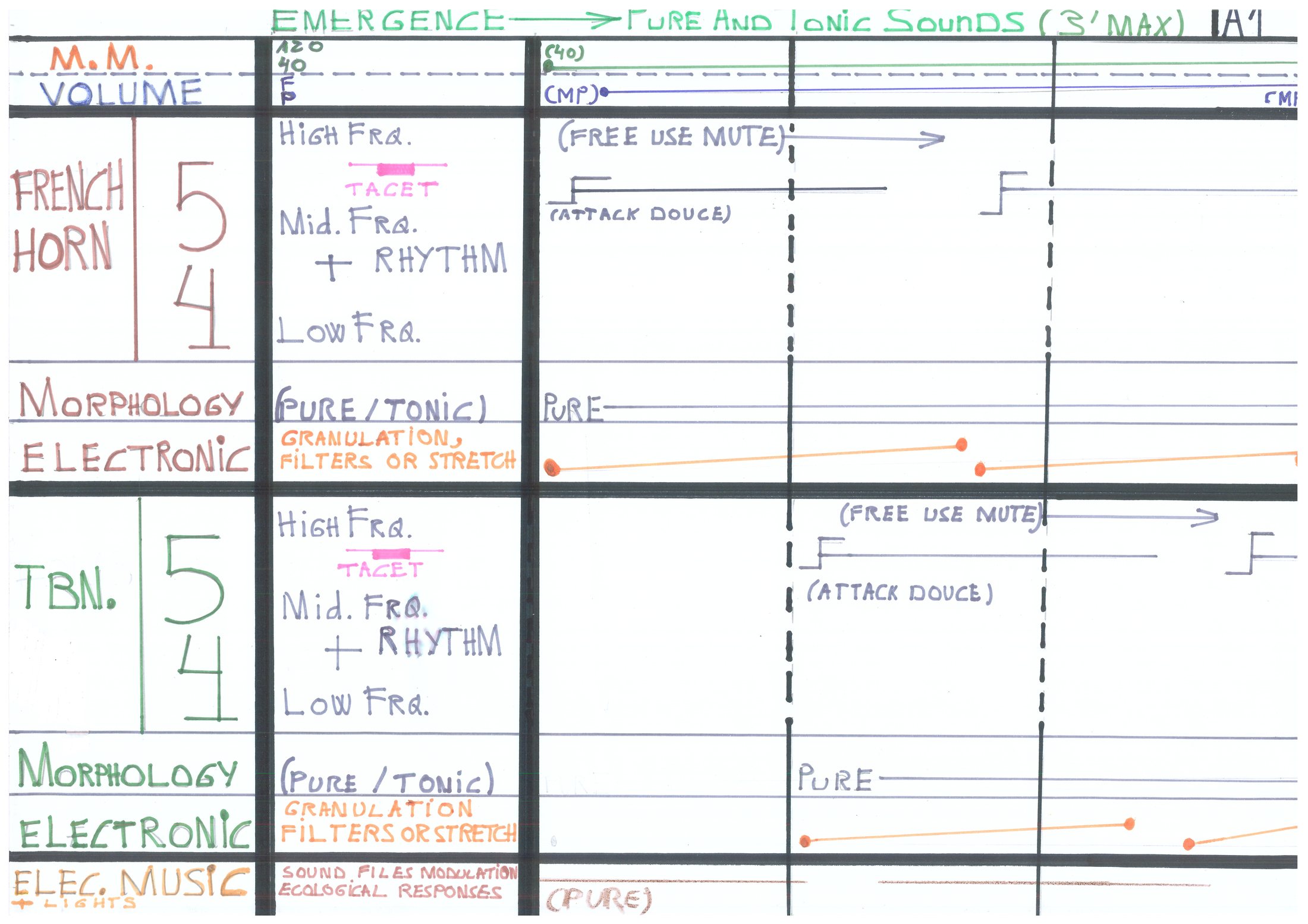
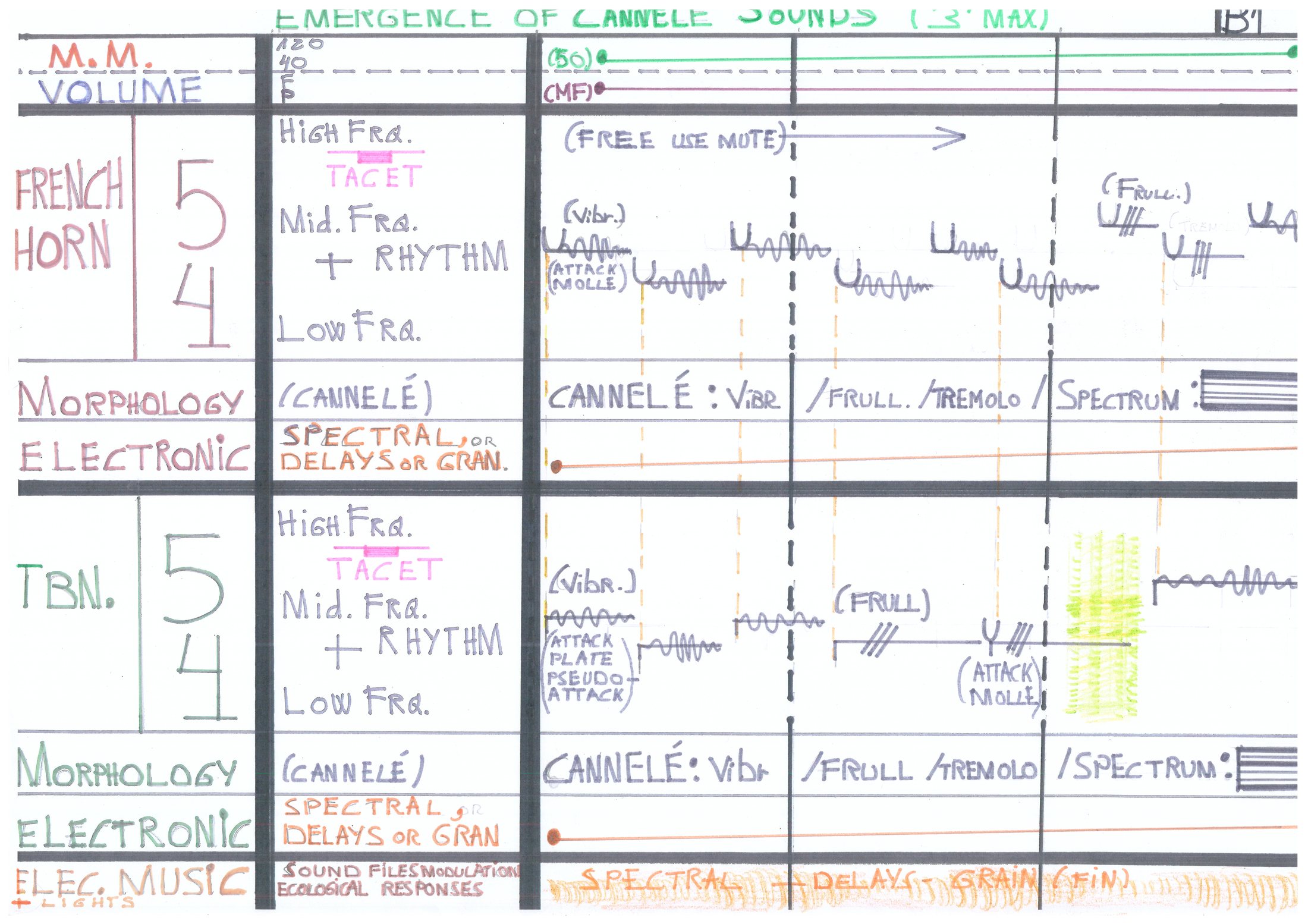
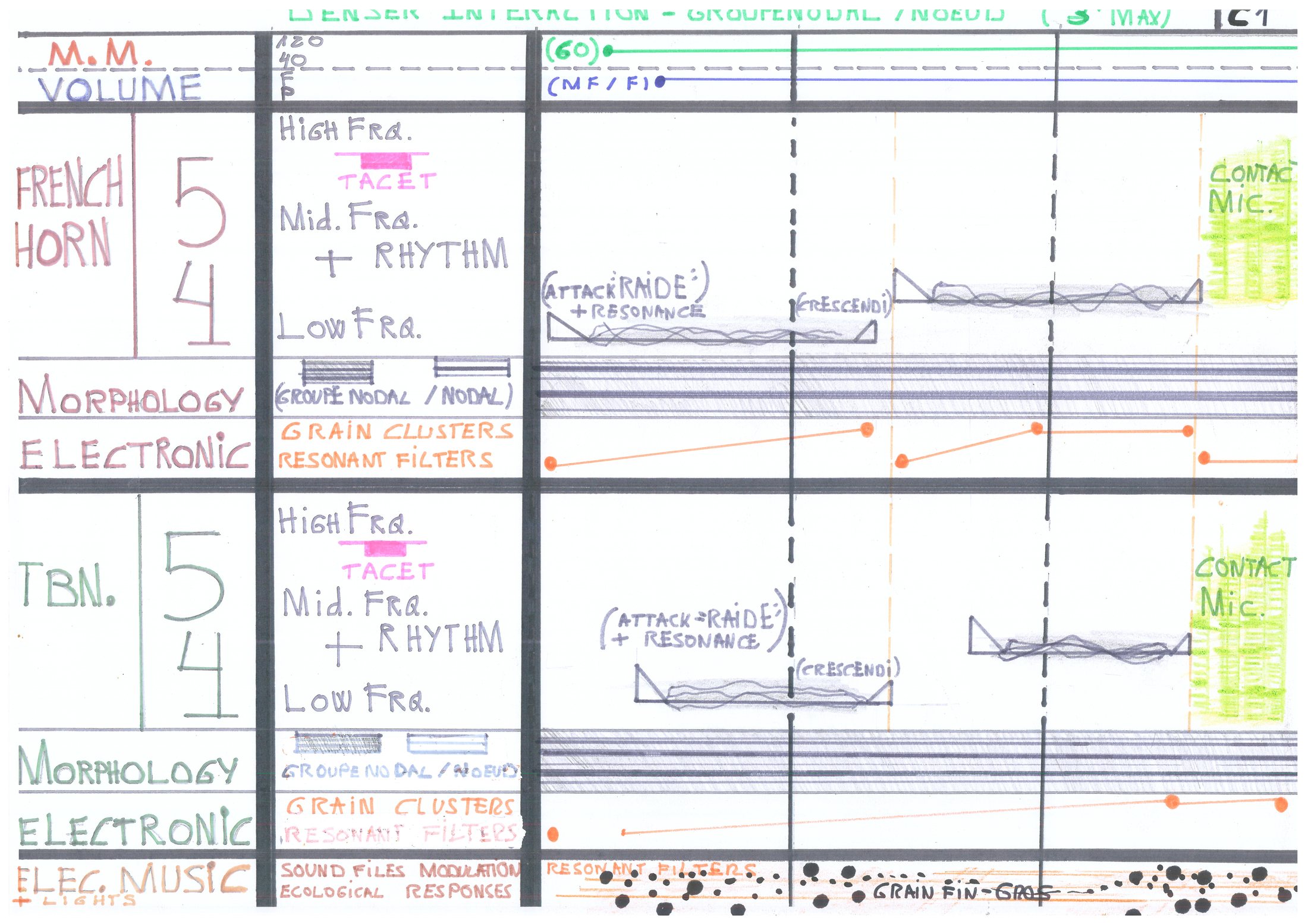
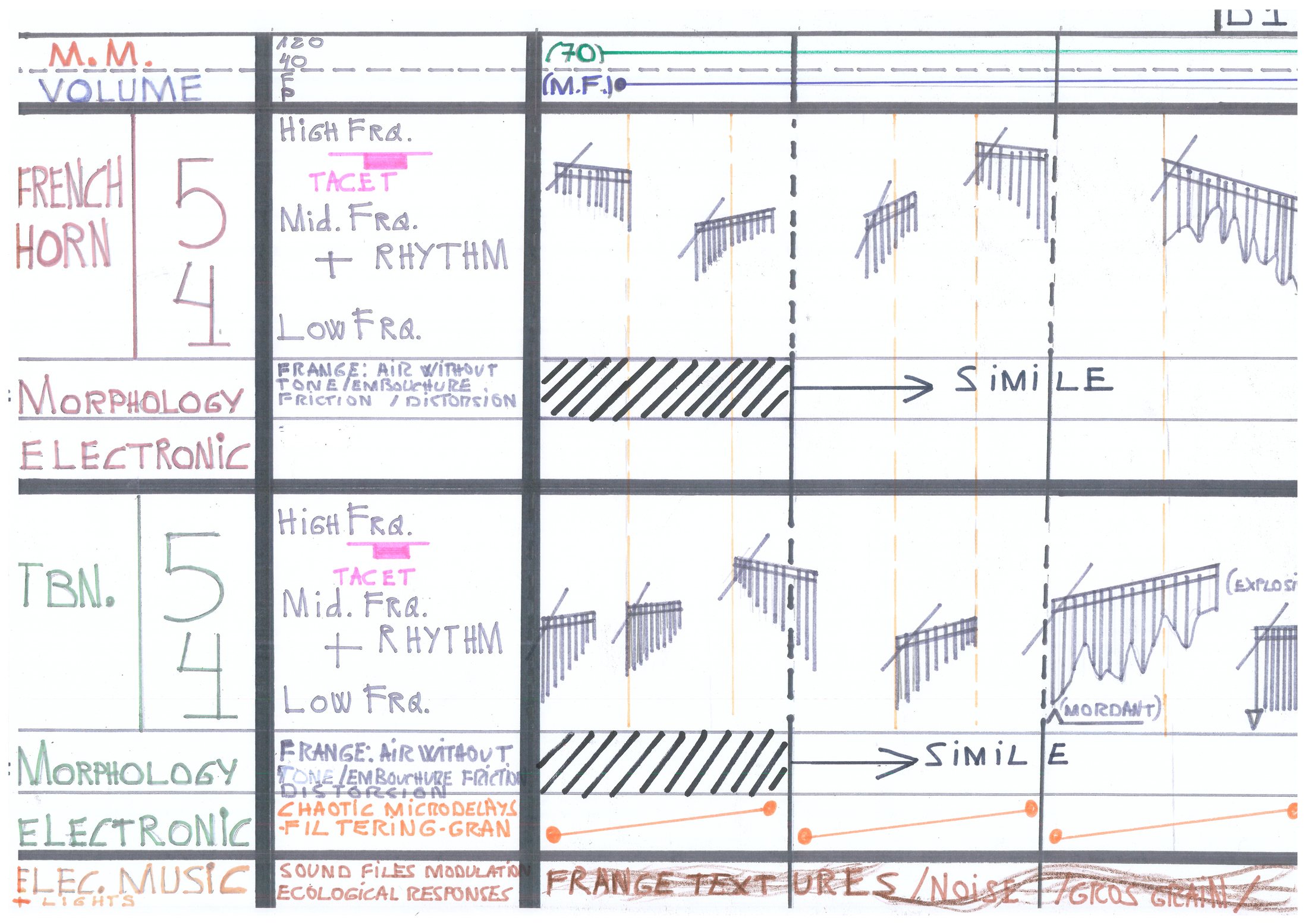
PUNTS DE LLUM A LES ALES DELS INSECTES · CICADA KILLER
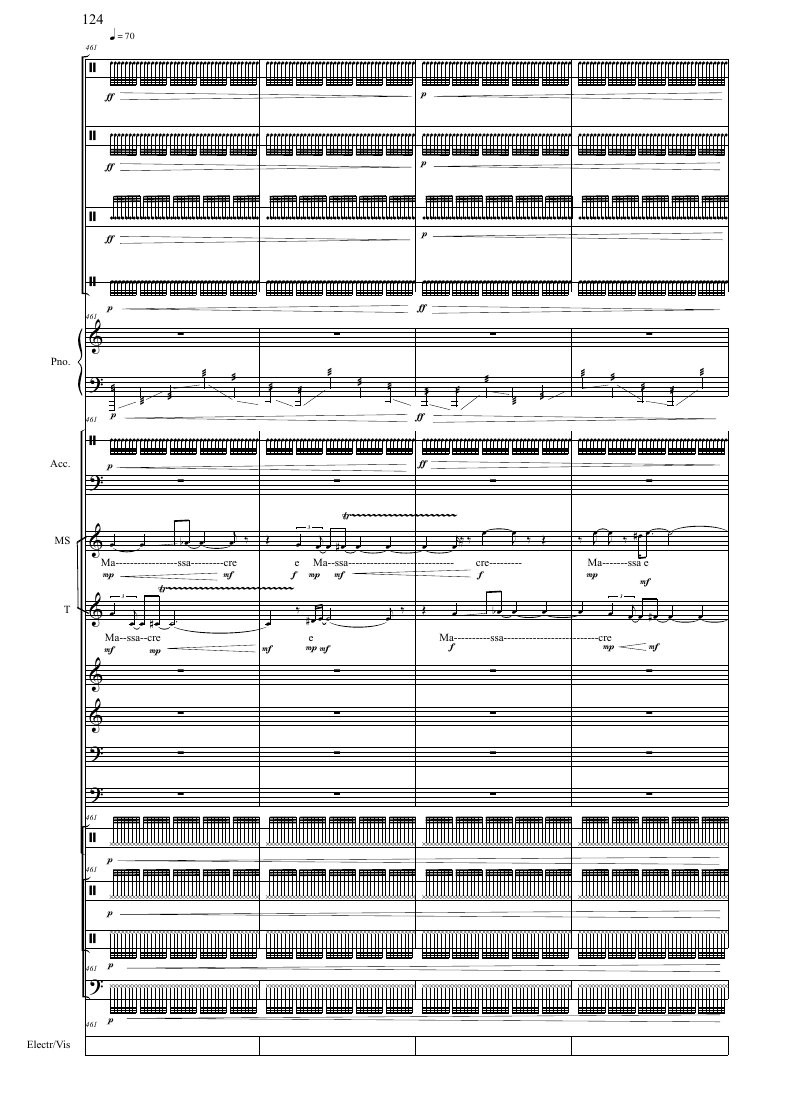
B · A new kind of graphic score
Notating the shape, not the note
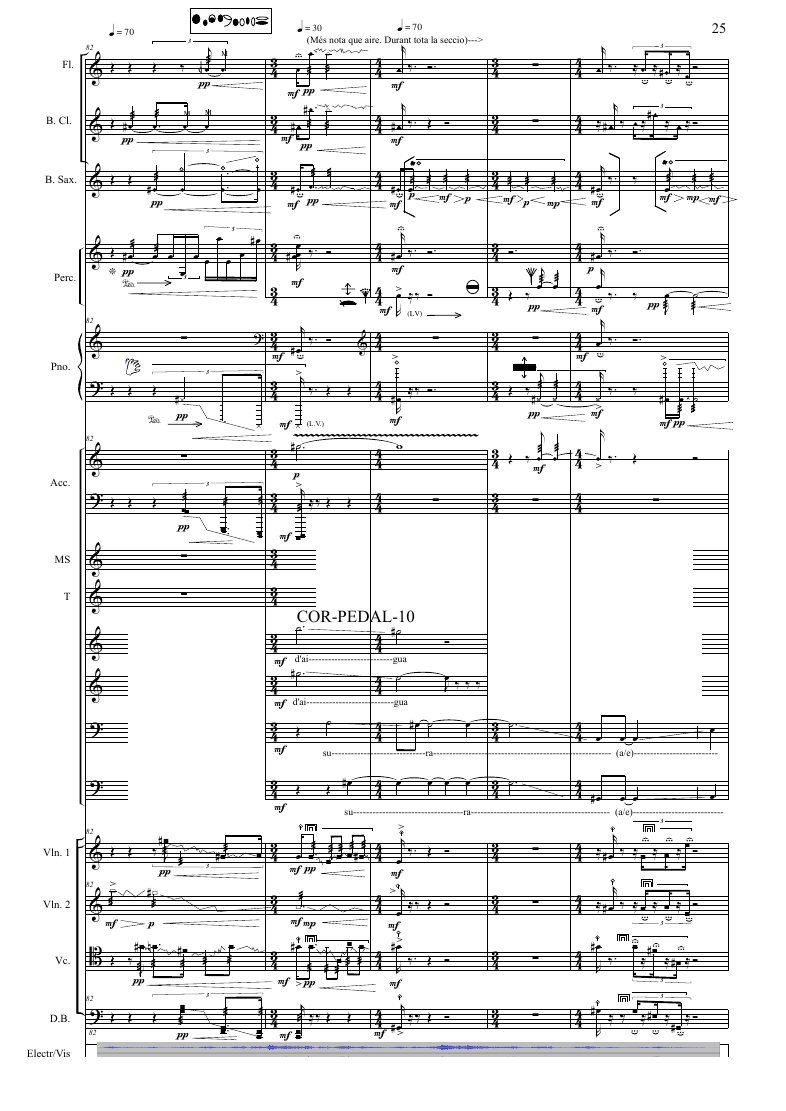
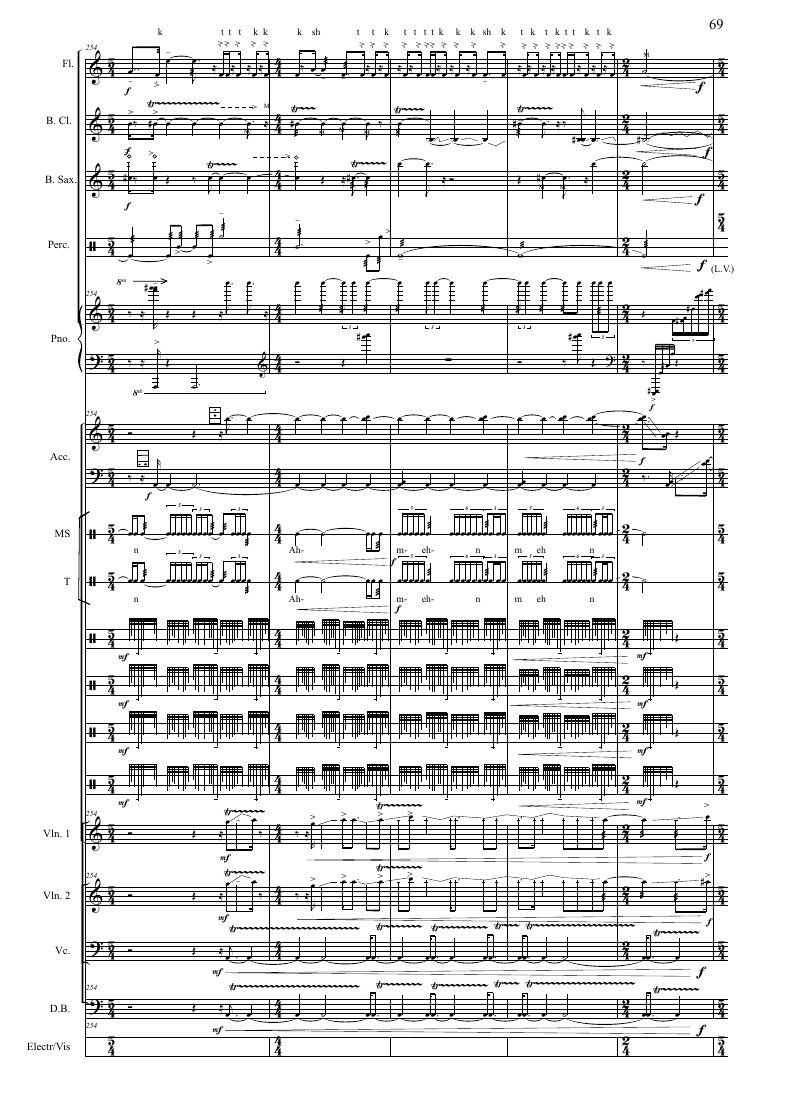
A graphic score based on Schaeffer’s sound morphologies and on the visual language of the spectrogram, to show the performer the sound materials to play.
Each performer searches, on their own instrument, the equivalent of each morphology: the technique is theirs to find.
A wide margin of freedom and action for the performer — while the control of form stays with the composer.
Fixed / open
Composer
morphology of each section, gestures, registers, order of pages, dynamic relationships, form
Performer
the technique that embodies each morphology, articulation, tempo within a margin
Electronics
transformation in real time, samples, and (in Cicada Killer) the form itself
Recommended reading for performers: M. Chion, Guide des objets sonores · P. Schaeffer, Traité des objets musicaux.
B · PUNTS DE LLUM A LES ALES DELS INSECTES · bass clarinet, microtonal accordion & electronics · Paris 2012 · Festival Eufònic
« Parlo d’un lent crepuscle que posava or tremolós a l’aigua amorosida, punts de llum a les ales dels insectes, solars reflectiments als ponts llunyans »
Gerard Vergés (Tortosa, 1931–2014)
“I speak of a slow twilight that laid trembling gold on the softened water, points of light on the wings of insects…”
A granular work inspired by the sound matter of the Ebro Delta: insects, tiny noises, indeterminate sounds — a metaphor of attentive listening, a whisper.
“Points of light on the wings of insects” — illustration
Electronics · Max/MSP
3 inputs (accordion ×2, clarinet) · real-time delay + pitch shift and granulation · 29 presets of fixed samples (space bar or USB pedal) · 3 faders on a nanoKONTROL2: an electronic performer mixes live, following the score.
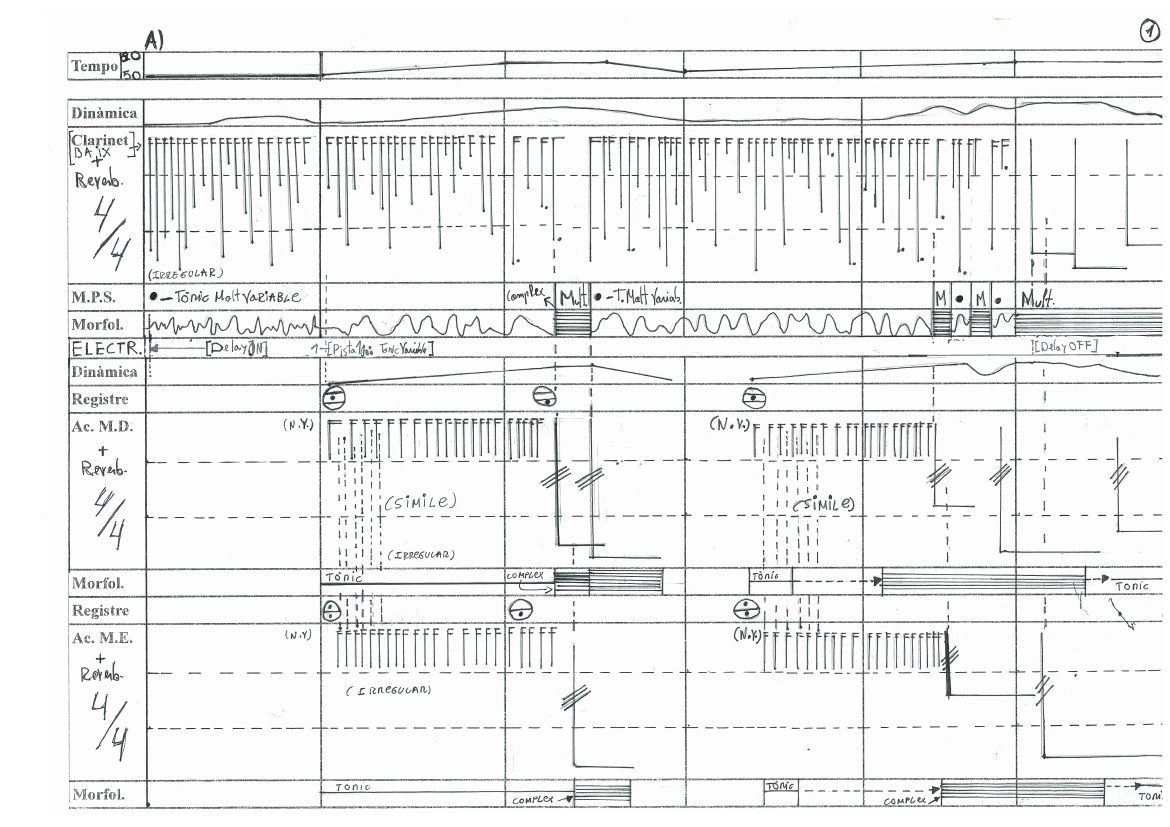
B · PUNTS DE LLUM · page A
How to read a page
Tempo and Dynamics: relative curves
Clarinet: events in time and register (vertical lines = attacks, dashed levels = register)
M.P.S. — mode of sound production: • note · M multiphonic · keys · air · frullato…
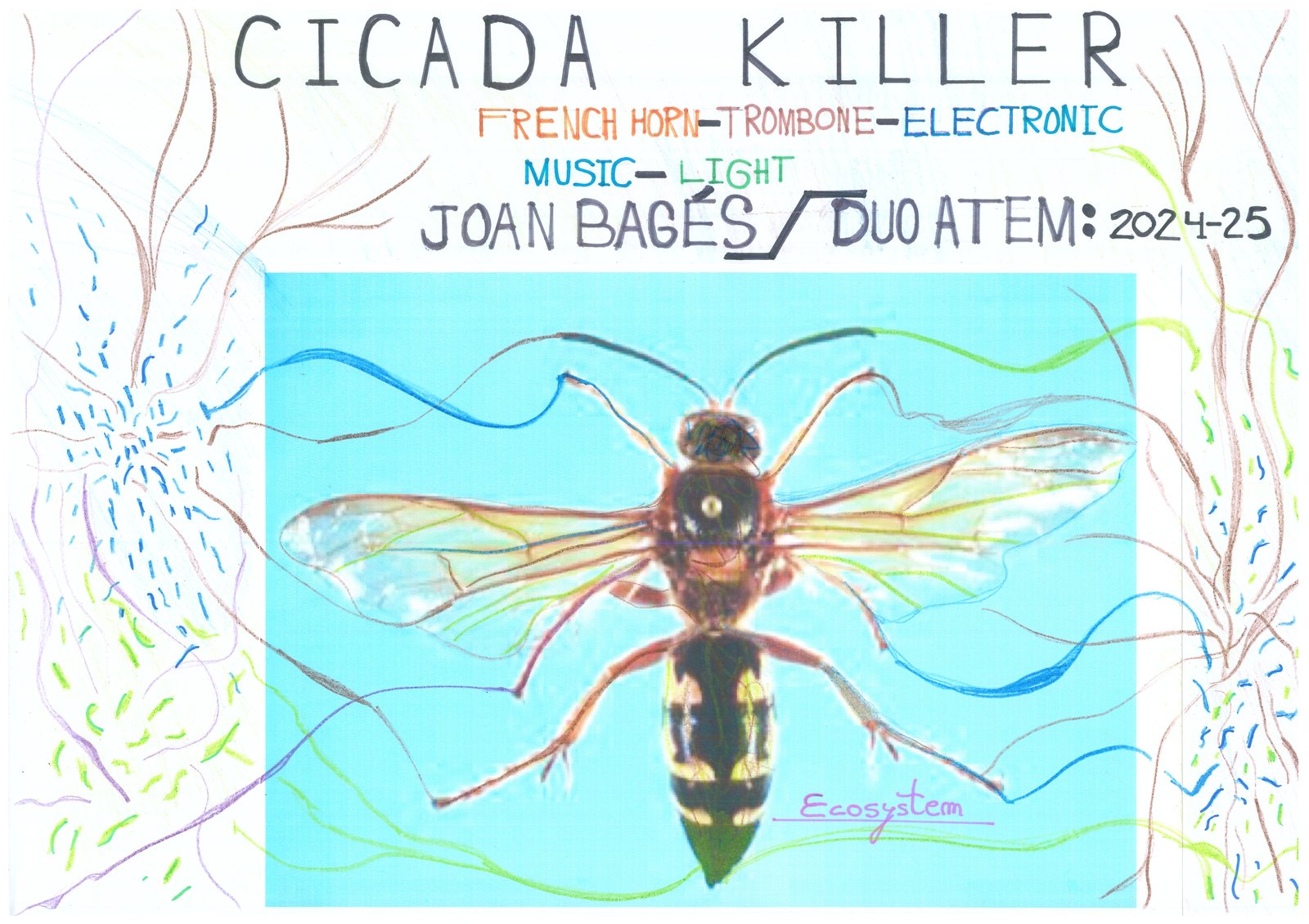
B · CICADA KILLER · horn, trombone, electronics & light · Flix–Stockholm–Barcelona 2024–26 · Duo Atem (Sören Hermansson, Ivo Nilsson)
A reactive sound ecosystem
The cicada and the wasp that preys on it — Sphecius speciosus, the “cicada killer”. The wasp does not kill: it paralyses the cicada and stores it alive for its larva. A cycle interrupted but not finished — an image of our relation with the planet.
Cicada · cycle intact
pure and tonic sounds
Predator · collapse
nodal and frange sounds
NEW IN MY RESEARCH · INTERACTIVE MUSIC & AI
The system listens and learns to take formal decisions, relating the morphological materials in real time. The form is no longer fixed: it emerges from performance.
It opens onto my current research in interactive music composition — beyond the scope of this lecture.
Score cover
B · CICADA KILLER · six sections, six morphologies
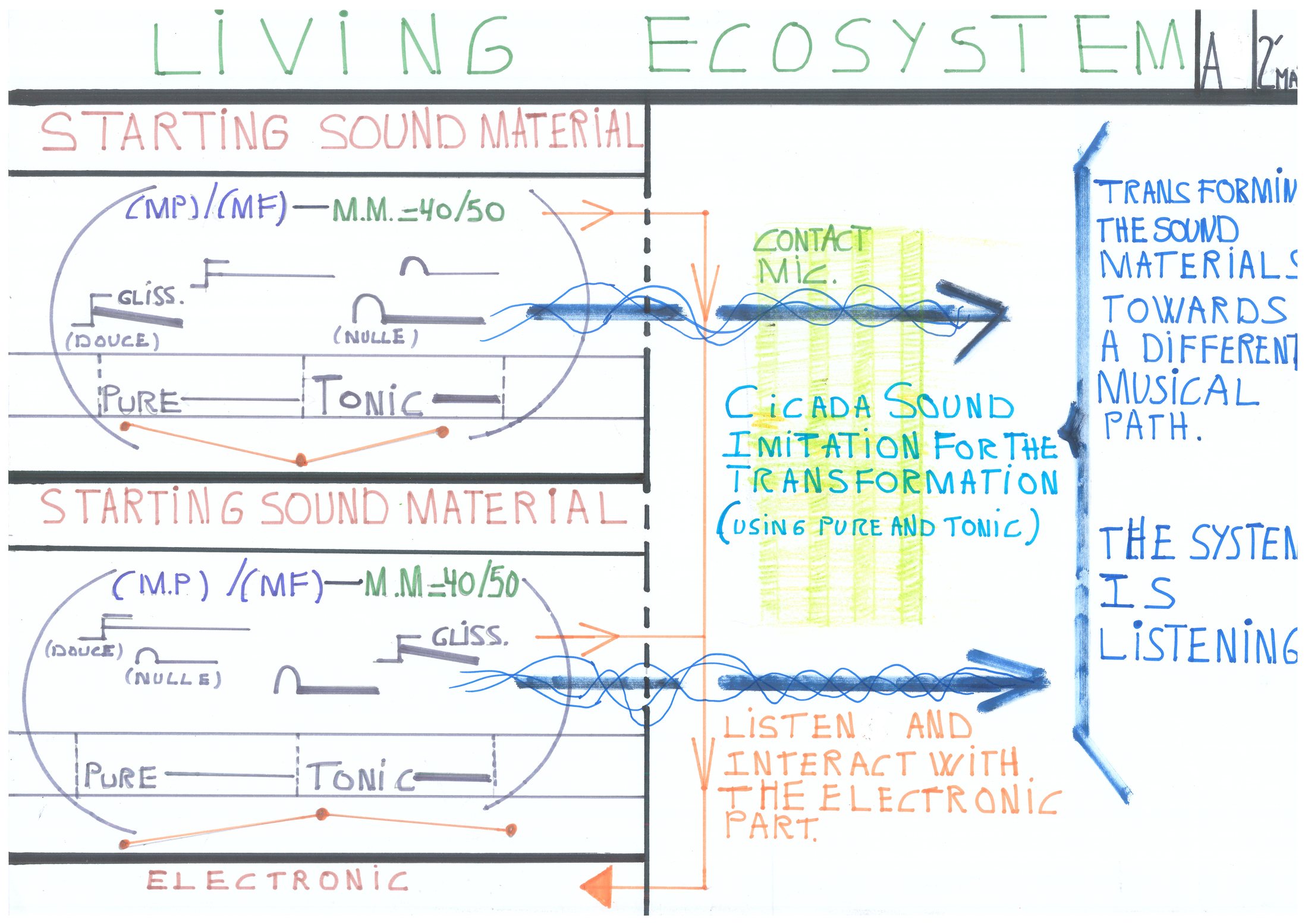
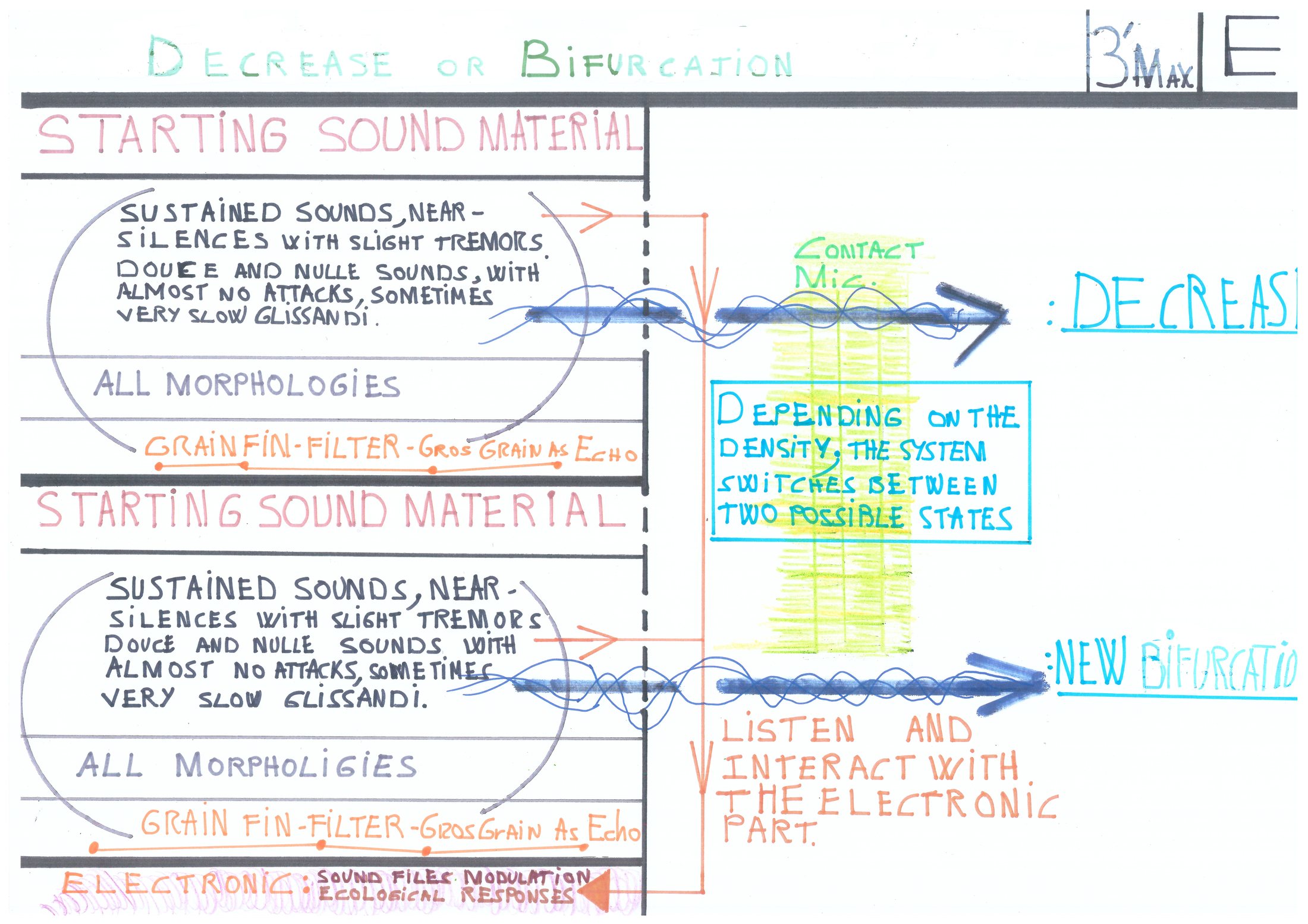
A · emergence — pure → tonicB · cannelé — vibrato, tremolo, frullatoC · nodal group and nodeD · frange — air, friction, distortionLIVING ECOSYSTEM — open last page of each sectionE · decrease or bifurcation · F · dissolution
The thickness, texture and colour of the line indicate the morphology · tempo and dynamics are relative · green blocks = contact microphone · bottom lanes = “Morphology electronic” and “Elec. music”.
B · CICADA KILLER · one description for music and light
Each section is a point in a 7-dimensional space
density
noise
attack
width
movement
tempo
dynamics
A · pure/tonic
0.10
0.05
0.05
0.15
0.10
0.25
0.30
B · cannelé
0.40
0.40
0.35
0.45
0.95
0.55
0.55
C · nodal/nœud
0.65
0.40
0.85
0.55
0.35
0.55
0.70
D · frange
0.95
0.95
0.90
0.95
0.20
0.75
0.80
E · decrease
0.25
0.30
0.10
0.40
0.25
0.35
0.25
E · bifurcation
0.45
0.50
0.50
0.50
0.70
0.50
0.60
F · dissolution
0.15
0.70
0.00
0.30
0.15
0.25
0.10
From cicada-seccions.json — the single file that drives the decisions and the light. Frullato counts as noise, not movement; D does not undulate, it breaks; F = air without sound (noise 0.70, density 0.15).
Listen · instrumental material per section
30″ excerpts from the section sound files of the electronic part (instrumental sounds structured by morphology).
B · CICADA KILLER · the loop the performers are inside
Five descriptors
density (inter-onset interval) · noise (spectral flatness) · attack · internal movement · dynamics
Nine rules, among them
A, B, C, D happen exactly once; F always closes
at least 1 minute of listening before any decision
E may return (max. twice), never twice in a row
turning the last page forces the change
never longer than 30 minutes
300
valid paths through the piece
10–19′
median duration, depending on how they play
“A duo that stagnates provokes changes; a duo that develops the material makes the system wait.”
B · CICADA KILLER · the cicada and its predator, measured
Spectral flatness
Geometric mean ÷ arithmetic mean of 7 octave bands (100 Hz – 6.4 kHz). It measures whether the energy is concentrated or spread — not where it is.
clean note (2 bands)
0.065
noise 0.00
note with frullato
0.449
noise 0.11
air and friction
0.990
noise 1.00
Unlike a high-frequency ratio, a clean high note still reads as tonic.
B · CICADA KILLER · the light is a third performer
150 individuals
A 5-metre strip of 150 LEDs on the floor: a population of coupled oscillators (Kuramoto model). Order parameter r: 1 = the whole population moves together · 0 = scattered.
each instrument owns a territory; brightness follows what it plays
the two colonies touch only in the contact zone
the colony senses a change before it happens: it becomes restless and loses unison
tonic electronics → the scene firms up; frange → everything dims and trembles
LED colony test · studio, FlixSynchrony and dispersion
05 · Research through works
C
The sonorous score
MATAR EL SOL · when the score is a sound in the performer’s ears
C · MATAR EL SOL · violin, cello, bass clarinet, electric guitar, electronics & video · Paris 2014 · for Nou Ensemble
From the electric to the acoustic
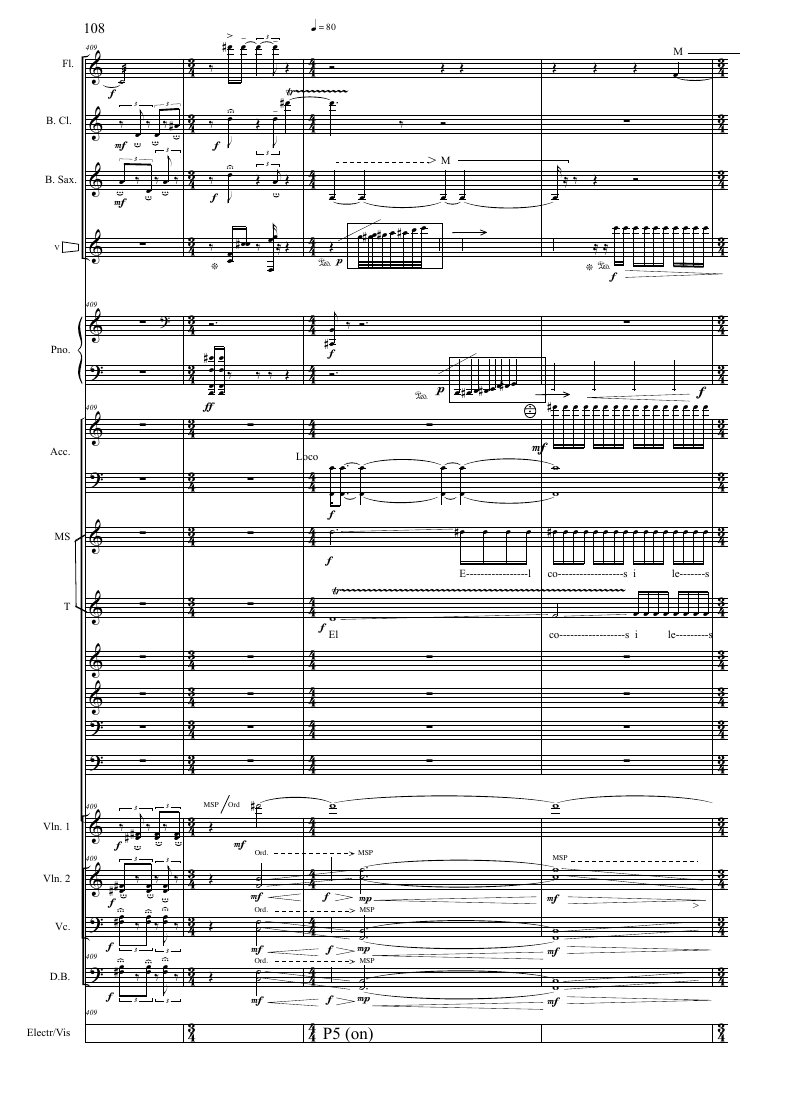
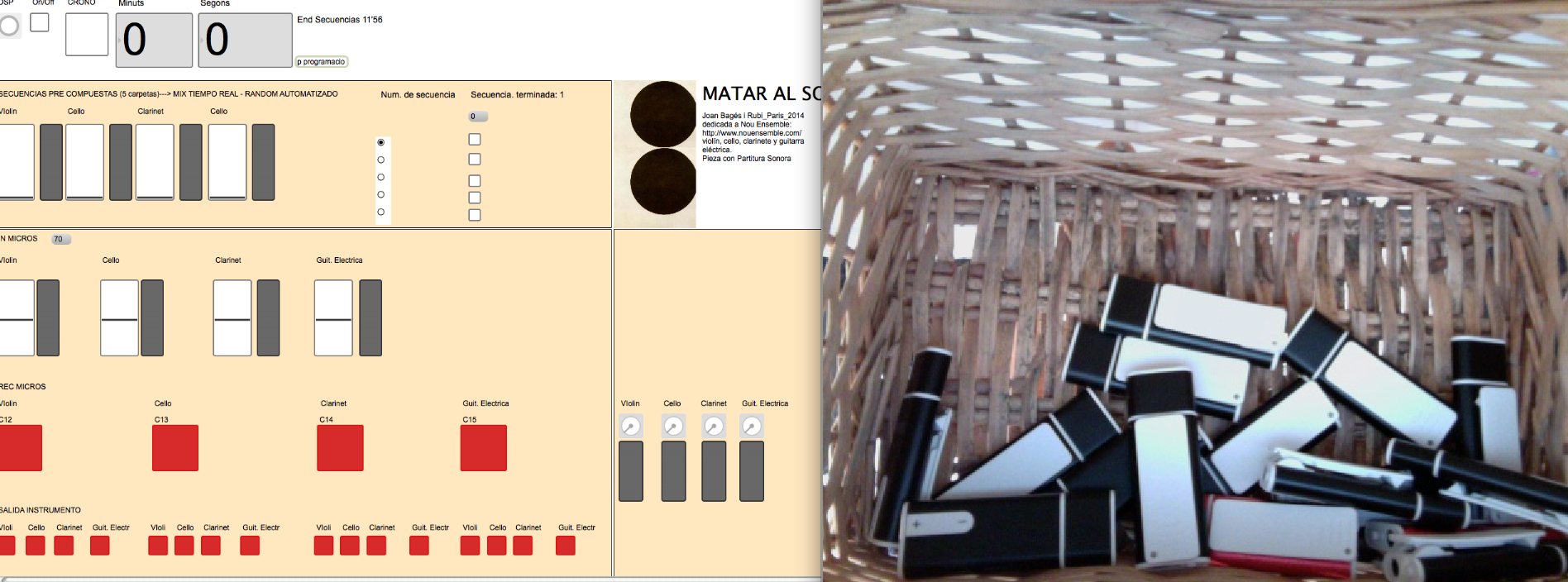
Performers wear headphones. A Max/MSP patch sends them, in real time, a stream of disparate electronic sounds built on sound morphologies.
Overwhelmed by information, they have one option: SELECT — and translate what they hear, with minimum delay, into acoustic energy on their instrument. First impression → reaction; then they can travel inside the sound.
“Composition with a sonorous score speaks of the transformation of one energy into another.”
NEW IN MY RESEARCH · THE COGNITION OF SOUND
The piece also speaks of how we perceive and recognise sounds, and which attributes we give them.
Theme: electricity. Victory over the Sun (1913 — Kruchenykh, Matyushin, Malevich): to “kill the sun” is to replace natural light with electric light.
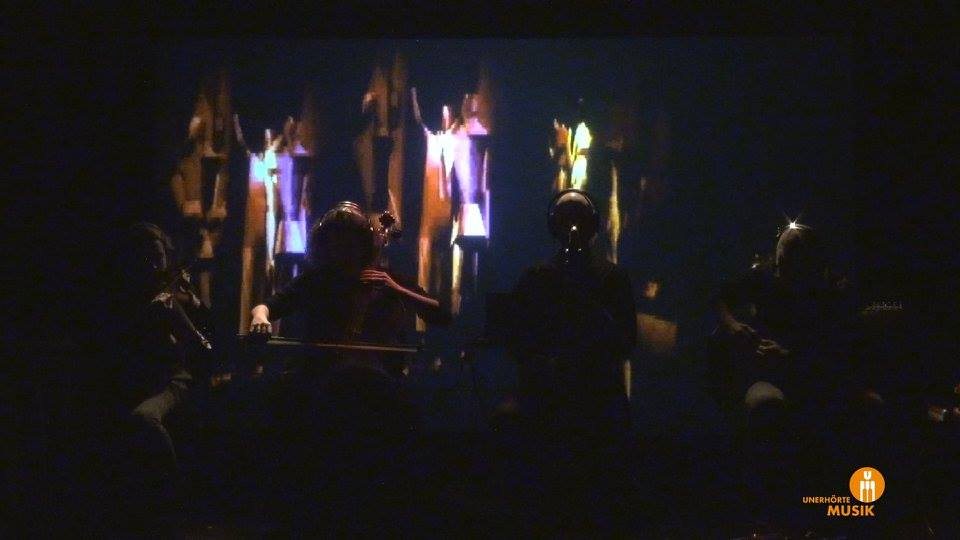
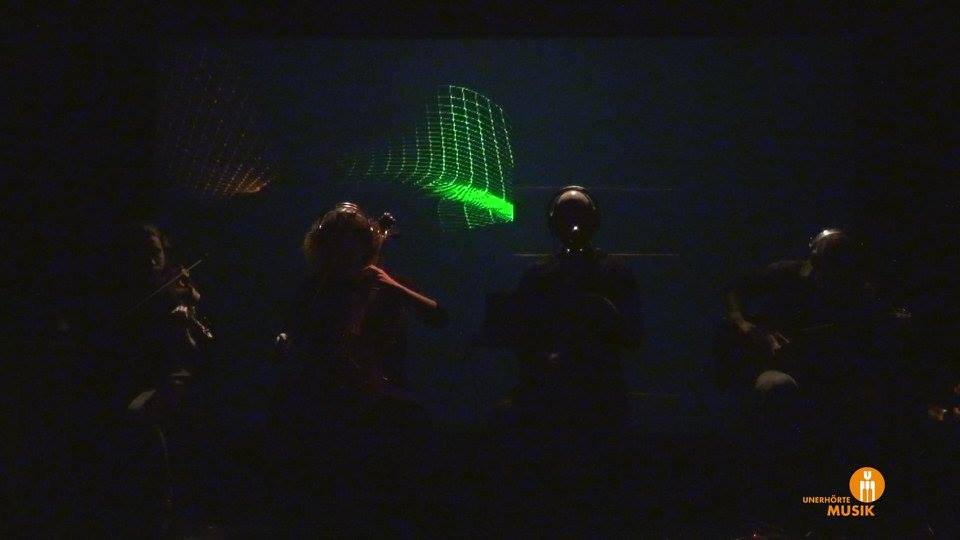
Nou Ensemble performing Matar el solVideo projections
C · MATAR EL SOL · three zones and a virtual score
The virtual score · 6 moments
1 Cello alone in Zone 1, puts on headphones
2 The others switch on all the mp3s, listen, enter one by one → superposition → concentration towards one point
3 From one point to all musicians → sound network
4 Sudden cut: composed sequences in the big headphones → another gesture, another listening
5 Back and forth between the composed and the live network
6 Minute 11: all share the same material; they return to the mp3s and switch them off one by one — the electric guitar ends
C · MATAR EL SOL · what the performers hear, and what we see
Nou Ensemble · excerpt (33″)
The Max/MSP patch · version 5: 5 sequences × 4 files
In the headphones · electronic sequences
Imagine you must translate this, right now, on your violin. What do you choose?
06 · Conclusion · the result of the research
What is composed is the relation
In spectro-morphological composition in differentiated layers, materials are not enough: what is composed is how morphological and spectral materials relate — from the object to the whole work — and how these relations change in time.
How many ways are there to relate morphologies? How do we compose those relations?
From the theoretical frame to the relation
Schaeffer
sound object · morphology
what relates: objects and their criteria
Vaggione · López López · Berenguer
grain · micro-time
relations inside the sound
Rebecca Saunders
sound palette
a finite set of sounds whose relations are composed
Smalley
spectromorphology · behaviour
relations in time: coordination, causality, dominance, coexistence
Kokoras
holophony
relations that produce one whole with focal points
06 · Conclusion · relations at every scale
From the object to the work
One question at every level: how does morphological and spectral material relate — inside a sound, between sounds, between sections?
 12345678